Páginas
CONTRA EL PINGALISMO CASTRISTA/ "Se que no existe el consuelo que no existe la anhelada tierrra de mis suenos ni la desgarrada vision de nuestros heroes. Pero te seguimos buscando, patria,..." - Reinaldo Arenas
jueves, febrero 14, 2013
Pasaporte SI, Protestas NO: Detenidas Berta Soler y otras 30 Damas de Blanco
lunes, diciembre 24, 2012
Embargoing Human Rights for Trade? The Sanctions Paradox
![]() |
| Laura Inés Pollán Toledo in Cuba and Aung San Suu Kyi in Burma |
Sanctions are the last nonviolent way of seeking to change an unjust system by refusing to cooperate with tyranny. When discussing the Cuban embargo in the mass media these two aspects are rarely, if ever, touched upon. Academics and the lobbyists for big business, such as USA Engage, often claim that sanctions never work; rather, it is economic engagement that leads towards greater respect for human rights.
However, recent history in China, Burma, and Vietnam indicate otherwise. This disconnect from reality stems from two factors: self-interest and a reading of power dynamics that ignores people power in favor of focusing on regime elites.
In a New York Times article entitled "Easing of Restraints in Cuba Renews Debate on U.S. Embargo," Carlos Saladrigas claims that “maintaining this embargo, maintaining this hostility, all it does is strengthen and embolden the hard-liners . . . what we should be doing is helping the reformers.” Essentially, Mr. Saladrigas argues that lifting sanctions would weaken and dissuade hardliners while at the same time benefiting reformers. Over the past four years the Obama Administration has loosened economic sanctions on Cuba.
If Mr. Saladrigas is correct, we should observe former outsiders in the regime tackling and winning policy discussions, but that has not been the case. On the human rights front the situation has actually deteriorated. One of the policy objectives of the Castro regime both internally and internationally is to portray itself as David against Goliath. Despite having normal trade relations, Hugo Chavez has undertaken the same kind of campaign in Venezuela. Often times the U.S. State Department has fallen short of explaining the sanctions policy fully or for that matter defending it in a vigorous manner at international forums. This has allowed the Cuban government a free hand in a sustained campaign to portray itself as a victim blaming all of its economic woes on the American blockade on Cuba.
Nevertheless as John Adams once observed, “Facts are stubborn things; and whatever may be our wishes, our inclinations, or the dictates of our passion, they cannot alter the state of facts and evidence.” The facts at present demonstrate that the arguments of the regime and its apologists do not hold up under scrutiny. First, one of the problems with the sanctions debate is that words are used interchangeably which are not synonymous while others that should be are not.
For example the Cuban government and many of its apologists use the terms blockade and embargo as if they were the same thing. At the same time the terms embargo and sanctions are viewed as somehow different. A blockade is specifically a military term that according to the Merriam-Webster Dictionary is “for the isolation by a warring nation of an enemy area (as a harbor) by troops or warships to prevent passage of persons or supplies.” In the case of Cuba there was only one time when a blockade was put in place and that was by President John F. Kennedy during the 1962 Cuban Missile Crisis beginning on October 22 and it was ended less than a month later on November 20, 1962.
What is known as the Cuban Embargo began On January 3, 1961 when President Dwight D. Eisenhower suspended trade with Cuba, a few days after his administration broke diplomatic relations with the country. The embargo on Cuba since its inception has meant restrictions on trade and travel to the island by U.S. citizens and in practice has been a partial embargo. Over the decades these sanctions have been loosened and tightened depending on the circumstances at the time.
An actual embargo would mean that there is a complete ban on or prohibition of trade by the United States with Cuba. This is not the case. What you have in Cuba is a partial embargo which is exactly the same in definition as economic sanctions. Between January 2000 and September 2012 according to the United State Census Bureau there has been $4,291,200,000.00 in U.S. trade in goods with Cuba.
The ban on U.S. imports from Cuba remains but U.S. exports to Cuba have been going on since 1992 with the amounts dramatically increasing since 2002 reaching its peak in exports to Cuba under the Bush Administration in 2008. Despite loosening restrictions further under the Obama Administration trade with Cuba has dropped to 363.3 million dollars in 2011 and figures for 2012 show a slight improvement with total sales to the island at $337.5 million as of September. This is not a total embargo but a partial one in which the United States is one of Cuba’s top trading partners.
At the same time Cuban exiles, many committed to maintaining economic sanctions against the dictatorship, are also a main source of remittances to their families on the island totaling hundreds of millions of dollars per year. The aim of the embargo initially, during the Cold War, was to penalize the Castro regime for seizing U.S. properties and limit its ability to fund armed guerrillas and terrorist groups in the region aimed at toppling friendly governments. With the exception of the Sandinistas in Nicaragua in 1979 this policy was a success in the Americas.
Following the collapse of the Soviet Union changes were made to sanctions policies that sought in the 1992 Torricelli Bill and 1996 Helms Burton Bill to make clear that sanctions would remain in effect until all political prisoners were freed, the government tolerated a political opposition and free elections were held. Funds were also set aside by Congress to assist through development assistance independent civil society. In addition Congress in the 1980s established Radio/TV Marti to break the information monopoly of the dictatorship. Also in the late 1980s the United States led an effort at the U.N. Human Rights Commission to expose the systematic human rights abuses on the island and hold the Cuban dictatorship to greater scrutiny.
The result of what amounted to a tightening of sanctions and redirecting them from Cold War considerations to a pro-democracy effort combined with diplomacy was to provide protection to Cuban dissidents on the island, along with the means to reach the populace via radio while also setting up licensing to permit the sending of humanitarian and technical assistance to dissidents by civil society groups in the United States. This led to the growth of the pro-democracy movement on the island and greater support for it internationally.
Policies have consequences
The loosening of sanctions and the lower profile on the international front has meant that the regime has not had to face the same level of accountability that it did back in 2003 for example. During the Black Cuban Spring of 2003 the international community’s response caught the Castro dictatorship by surprise with a sustained campaign to release 75 Cuban prisoners of conscience arrested during the March 18 crackdown and sentenced up to 28 years in prison.
None of the 75 are serving their sentences in a Cuban prison today. So what have we witnessed in Cuba over the past four years? The deaths, under suspicious circumstances, of national opposition figures such as Laura Inés Pollán Toledo and Oswaldo José Payá Sardiñas; The deaths of Orlando Zapata Tamayo and Wilman Villar Mendoza, human rights defenders on hunger strike in the custody of the Cuban authorities; and, an increase both in the number of detentions and the degree of violence used against nonviolent activists.
Over the past four years there has been a dramatic increase in the number of arbitrary detentions in Cuba: from 870 in 2009 to 5,625, thus far, in 2012. One example of this disturbing trend is the death of Juan Wilfredo Soto Garcia from pancreatitis, caused by the brutal beating he received from Cuban government agents.
Another is that of American Alan Gross, arrested on December 3, 2009 and sentenced to 15 years in a Cuban prison. He spent 25 days in a Havana jail before being visited by a U.S. diplomat. By that time Alan Gross had been approached by a Cuban “attorney” who just happened to be representing five Cuban spies imprisoned in the United States for espionage and conspiracy to commit murder. This Cuban attorney represented Alan Gross before his show trial and later appeals. Alan Gross’s supposed crime: Attempting to provide Internet access to the local Jewish community in Cuba. The reality is that he is a pawn of the Castro regime to be used in pressuring concessions from the Obama Administration.
The Administration dangled several offers to the Castro regime and made a unilateral concession:
- Take Cuba off the list of state sponsors of terrorism.
- Waive probation for one of five Cuban agents convicted of espionage in the United States that planned at least one terrorist attack in the United States and provided intelligence that led to the downing of two US civilian planes over international airspace on February 24, 1996 killing four.
- Cuba democracy programs would no longer be about promoting democracy but "building civil society."
- The White House and Senator John Kerry pushed to unilaterally cut money for the Cuba democracy programs and freeze their funding.
In Burma, on the other hand, where sanctions were maintained, there have been signs of improvement in rights protections. The military junta, after years of trying to manipulate its way out from under them, has had to recognize the political opposition and provide a space for them in Burma's parliament. Things are still far from perfect, but there is hope that serious and permanent reforms are underway. The ability of Aung San Suu Kyi to run for public office, and for an independent press to begin to operate in Burma following decades of systematic censorship and control, are both positive signs. Aung San Suu Kyi has been clear about the importance of sanctions and of confronting those that would engage the dictatorship at the expense of the human rights of the Burmese people:
“Investment that only goes to enrich an already wealthy elite bent on monopolizing both economic and political power cannot contribute toward égalité and justice, the foundation stones for a sound democracy. I would therefore like to call upon those who have an interest in expanding their capacity for promoting intellectual freedom and humanitarian ideals to take a principled stand against companies that are doing business with the Burmese military regime. Please use your liberty to promote ours.”Prominent Cuban-American businessmen have also spoken out against unconditionally lifting sanctions in Cuba, stating in a letter titled “Commitment to Freedom” that “absent the dismantling of the totalitarian apparatus on the island, along with the unconditional release of all political prisoners and the restoration of fundamental human rights, there should be no U.S. unilateral concessions to the Castro regime." They, like Aung San Suu Kyi believe that it is unprincipled for companies to do business with a dictatorship exploiting the suffering of an oppressed people. Things are improving in Burma on the human rights front, while relations are worsening in China and Vietnam. Linking human rights with economic engagement has been a winning formula in Burma- and there’s hope that it can be in Cuba as well.
Room for improvement
However, there are always opportunities for improving sanctions policies- seeking out approaches that make the people, and not the dictatorship, the priority. For example on August 4, 2011 the Obama Administration announced a ban on visas for people who the State Department finds have been involved in human rights violations. Unfortunately, since then we have seen that human rights violators of the Castro regime are immigrating to the United States. If this ban were applied vigorously to the hardline elements of the Cuban regime it would be positive step that would protect dissidents by holding abusers accountable and providing a penalty, but this ban also needs to be expanded to follow the path taken by the European Union when dealing with the Mugabe regime in Zimbabwe. Banning the relatives of the hard line elements of the dictatorship from visiting the United States would create greater pressures on the regime for change.
Unfortunately, what has gone on in practice is that the children and relatives of the hard liners have an easy time obtaining visas to the United States while the families of dissidents have a more difficult time.
There are two profoundly different visions of how to achieve positive change in Cuba. One views the populace and their representatives in the emerging independent civil society, or dissidents, as the protagonists of change. The second views regime elites and possible reformist elements within the dictatorship as the protagonists for change. The trouble with the latter view is that it often mistakes profiteering with progress, as China has demonstrated. This approach also undermines the morale of dissidents and the populace at large, thus emboldening the dictatorship. History has shown us that change occurs from the ground up. Thus, when sanctions are lifted in an effort to allow elements within the regime to reform, the action actually has the opposite effect. The paradox is that the most effective way to encourage reform is to empower dissidents by pressuring the regime with sanctions. If the current policy of loosening sanctions and not holding the regime accountable for its gross and systematic human rights violation, beyond pro-forma denunciations of atrocity after atrocity then things will get a lot worse and they will never improve for Cubans.
U.S. sanctions policy with regards to the dictatorship in Cuba was about containment of the exportation of the Cuban model throughout the hemisphere, and during the Cold War having Cuba serve as a drain on Soviet resources that contributed to its eventual bankruptcy. In the post Cold War years it shifted once again with a focus on human rights. The failure of the United States to do this in China, Cambodia, Venezuela and Vietnam with their deteriorating human rights situation is not that the policy in Cuba is incorrect as some would claim but that the policies in these other countries are profoundly immoral and ignore human rights concerns. Instead these policies favor of short-term corporate economic interests that run counter to the interests of the majority of U.S. citizens not to mention the long term economic well-being of the United States.
Embargoing Human Rights for Trade? The Sanctions Paradox
lunes, octubre 15, 2012
Damas de Blanco rinden homenaje a Pollán pese a "represión"
![]() |
| (AP Photo/Ramon Espinosa) |
"Vamos a marchar, pese a la represión del gobierno cubano. Muchas Damas de Blanco (...) están detenidas desde ayer (sábado) y hoy para impedir que pudieran estar aquí, pero más o menos unas 50 mujeres estamos representando a todas las que no pudieron llegar", dijo Soler a la prensa.
Soler, quien sustituyó a Pollán como líder del grupo tras su deceso el 14 de octubre de 2011 a causa de un paro cardiorrespiratorio, no precisó el total de mujeres detenidas, pero dijo tener reportes de al menos "12 detenciones en La Habana, seis en Villa Clara (centro) y cuatro en Matanzas (occidente)".
"Las Damas de Blanco estamos de luto, pero también con mucha fuerza", porque "estamos siguiendo el legado de Laura", añadió Soler, al iniciar la caminata por la Quinta Avenida, en el oeste de La Habana, después de acudir a misa en la iglesia de Santa Rita.
"!Laura Pollán vive!", "!Libertad, libertad, libertad!", gritaron frente al templo las mujeres, que marcharon portando gladiolos rosados y vistiendo una camiseta blanca con una imagen en la que Pollán hace la L de la libertad con su brazo derecho en cabestrillo.
Soler explicó que el homenaje incluyó esta semana jornadas de oraciones y la apertura de un libro de firmas para rendir tributo a Pollán, en su antigua casa, convertida en sede del grupo y cuyos accesos están cerrados por la policía al tránsito de vehículos desde la noche del viernes, según constató la AFP.
El grupo Damas de Blanco, que recibió el Premio Sajarov del Parlamento Europeo en 2005, fue creado por esposas y familiares de 75 opositores detenidos en 2003, ya todos liberados, entre ellos el esposo de Pollán, Héctor Maseda, quien acudió este domingo a la iglesia aunque no participó en la caminata.
"Ella (Pollán) desafío al régimen en todos los órdenes, le ganó la calle contra todos los pronósticos" y las Damas de Blanco "no pueden abandonarla. Ese es el legado de Pollán", declaró a la AFP Maseda, de 69 años.
El gobierno de Raúl Castro acusa a las Damas de Blanco de ser "punta de lanza" de la subversión en la isla y las califica, al igual que al resto de la oposición, de "mercenarias" de Estados Unidos.
Damas de Blanco rinden homenaje a Pollán pese a "represión"
domingo, octubre 14, 2012
Pachanga robo-ilusionaria por aniversario de Laura Pollan
"A la sombra de la bandera cubana y del 26 de julio la juventud cubana le da clases de baile a mercenarias del imperio"
Pachanga robo-ilusionaria por aniversario de Laura Pollan
miércoles, abril 18, 2012
NED Took Laura Pollan Medal to Havana
NED Medal Honoring Laura Pollán Presented in Havana
In an unprecedented act of international solidarity, the National Endowment for Democracy presented its Democracy Service medal to the family and colleagues of Laura Pollán in Havana.
Vice-Chair of NED’s Board of Directors Judy Shelton visited Cuba in March 2012, delivering the Democracy Service Medal awarded by NED to the late Laura Pollán and the Damas de Blanco last December. Shelton presented it in person to Berta Soler, the leader of the Damas de Blanco movement founded by Laura Pollán; Héctor Maseda Guitiérrez, Pollán’s widower and a journalist who spent eight years imprisoned by the Cuban government; and Laura Labrada Pollán, Pollán’s daughter and a member of the Damas de Blanco.
While the Ladies are the frequent focus of international recognition, this is the first time that an international organization has honored them in their own country. The presentation in Havana was an important act of solidarity with the Damas de Blanco at a time when they and other activists face heightened repression and physical attacks.
Pollán founded the Damas de Blanco when her husband was arrested along with 74 others in the “Black Spring” of 2003, rallying other women whose loved ones had been imprisoned. The women held weekly marches, dressed in white to symbolize the purity of their motives and carrying gladioli. She passed away on Oct. 14, 2011, several weeks after the Damas de Blanco were attacked by a mob. She was posthumously honored with the Democracy Service Medal at a special Capitol Hill ceremony on December 14, 2011, which Soler, Maseda and Labrada Pollán joined by teleconference.
NED Took Laura Pollan Medal to Havana
miércoles, diciembre 14, 2011
Obama honors Laura Pollan but ...
viernes, diciembre 09, 2011
NÉMESIS-OTTAWA by Geandy Pavón ( The Full Version) Music by Paquito D' Rivera
martes, noviembre 29, 2011
Laura Pollán en Radio Martí la noche de su llegada ante Dios
domingo, noviembre 20, 2011
Yoani Sanchez sobre NEMESIS-OTTAWA
miércoles, noviembre 16, 2011
martes, noviembre 15, 2011
En la propia embajada cubana en Otawa/ Némesis Ottawa: Homenaje a Laura Pollán (Teaser)
Homenaje a Laura Pollán en los muros de la embajada de #Cuba en Otawa por Geandy Pavón
'Némesis Laura Pollán' en la embajada de #Cuba en Otawa, Canadá, por Geandy Pavón. La acción tuvo lugar anoche. Aquí una serie de fotos, cortesía del artista.
Cortesia de Punt de Vista
Homenaje a Laura Pollán en los muros de la embajada de #Cuba en Otawa por Geandy Pavón
sábado, octubre 29, 2011
Dr, Biscet analiza la muerte de Laura Pollan
miércoles, octubre 26, 2011
jueves, octubre 20, 2011
Laura, el Reverendo, Palacios y las preguntas del Idiota
ahora un grupo de disidentes encabezados por palacios y farinas al parecer, afirman que no desean ser atendidos en los hospitales del regimen. bueno lo primero es lo primero y lo segundo es lo segundo, como sabe muy bien cualquier hiijo de kubiche:
las muestras de tejido y pelo de laura que, en una verdadera operacion de contrainteligencia, tomo el narrador para enviarlas secretamente al exterior, lo unico que pudieran probar es que laura fallecio como resultado de un conjunto de factores agresivos que colapsaron su organismo.
no hubiese sido mas sensato y practico, que ese asombroso y eficiente operativo desplegado a velocidades que harian palidecer de verguenza a cualquier superagente de la ex kgb, se hubiera desplegado para evitar su muerte?
pregunto porque evidentemente soy mas idiota que lo que pensaba.
Laura, el Reverendo, Palacios y las preguntas del Idiota
Piel y cabello de Laura irán al extranjero para determinar la causa de su muerte
| Publicado por Net for Cuba International |

Por Rev. Ricardo Medina Salavarría, recibido en Univisión Online por cortesía de Húber Matos, CID.
Piel y cabello de Laura irán al extranjero para determinar la causa de su muerte
lunes, octubre 17, 2011
Laura Pollan: Otra muerte sobre la conciencia colectiva
domingo, octubre 16, 2011
"LAS CASUALIDADES QUE ASESINARON A LAURA POLLAN"
La inexplicable muerte de Laura Pollán [y los que miran para el otro lado]
Patria Pueblo y Libertad
Por Ricardo Medina [Secretario de Asistencia a Presos Políticos y miembro del Comité Ejecutivo Nacional del partido Cuba Independiente y Democrática].La embajada de España estuvo ausente. Los gobiernos latinoamericanos han guardado silencio. El vicepresidente colombiano Angelino Garzón, de visita en La Habana, estaba muy ocupado denunciando el “bloqueo” de los Estados Unidos y feliz de codearse con los socios de la tiranía.
La muerte de Laura Pollán merece investigarse; pero los corresponsales de la prensa extranjera en Cuba no llegaron a indagar qué había pasado. Patricia Janiot de CNN dio la noticia, pero por lo menos no validó que el fallecimiento fuera por complicaciones infecciosas. Quien haya informado como normal esta tragedia no hizo su tarea o le hace el juego a los culpables.
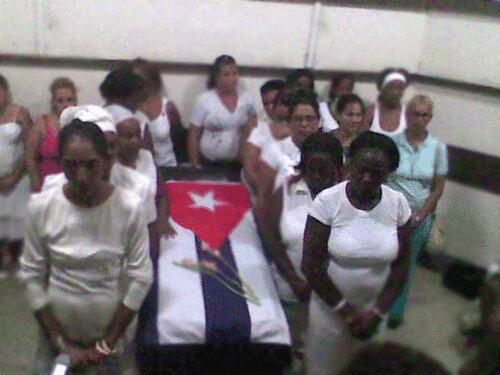
Para evitar que su cuerpo se velara en la antigua funeraria Rivero, que tiene todas las condiciones, el régimen simplemente la dejó sin electricidad. Tuvieron que ir a la funeraria nacional, donde los empleados estatales se negaron a cambiar de ropa a la difunta, tarea que - como un privilegio - asumió el presbítero Ricardo Medina Salabarria,* quien estuvo a cargo de los oficios religiosos.
Como era de esperar, en la funeraria nacional les asignaron un lugar incómodo y caluroso. El velorio fue a la carrera, solo dispusieron de poco más de una hora. En una ciudad donde para cremar un cuerpo hay que ponerse en lista de espera, el régimen se encargó de que fuera de inmediato. La cremación desaparece evidencias.
Orlando Zapata Tamayo también tuvo una muerte inexplicable. No es posible que un preso pierda la vida en una huelga de hambre cuando los recursos médicos están disponibles para hidratarlo y alimentarlo aun contra su voluntad. Lo asesinaron. Otra muerte extraña fue la de José Wilfredo Soto en Santa Clara, una golpiza en un parque, un arresto violento y unos días después, según la dictadura, el opositor falleció de muerte natural. También Camilo Cienfuegos desapareció sin dejar rastros.
En este país, cuyo gobierno se ufana de ser una “potencia médica”, es bien raro que alguien tan importante como Laura, pierda la vida tan rápidamente. Ahora resulta que hasta el dengue tuvo que ver. Extraño, porque en La Habana no está muriendo nadie por dengue. Extraño, porque los médicos hicieron creer que Laura había mejorado. De pronto, un paro cardiaco, un velorio instantáneo y una cremación inmediata. En altas hora de la noche, cuando casi no hay gente.
Las últimas agresiones contra Laura y sus valientes mujeres fueron una declaración de guerra total. Para la tiranía, Laura Pollán había crecido demasiado. Cuando ella declaró que el respeto a los derechos humanos en Cuba era parte fundamental de la agenda de las Damas de Blanco, el régimen entendió la dimensión del reto. Ya no eran solo las Damas de Blanco de la Habana. El CID se había encargado de organizar Damas de Blanco de apoyo en Pinar del Río y Oriente, en Camagüey se daban los primeros pasos. Cuando salió de prisión Daniel Ferrer, organizó en Oriente su refuerzo. Otras organizaciones empezaban a sumarse.
Fue un noche extraña y dolorosa. Aquel ramo de flores de los estadounidenses fue a hacerles compañía a dos más: el de sus valientes y leales compañeras de las Damas de Blanco y el de los hombres y mujeres del CID que siempre creyeron en ella. Laura siempre vivirá en la lucha de los cubanos por su libertad.
La inexplicable muerte de Laura Pollán [y los que miran para el otro lado]
"EN TIEMPOS DIFÍCILES" - Heberto Padilla
A aquel hombre le pidieron su tiempo
para que lo juntara al tiempo de la Historia.
Le pidieron las manos,
porque para una época difícil
nada hay mejor que un par de buenas manos.
Le pidieron los ojos
que alguna vez tuvieron lágrimas
para que contemplara el lado claro
(especialmente el lado claro de la vida)
porque para el horror basta un ojo de asombro.
Le pidieron sus labios
resecos y cuarteados para afirmar,
para erigir, con cada afirmación, un sueño
(el-alto-sueño);
le pidieron las piernas
duras y nudosas
(sus viejas piernas andariegas),
porque en tiempos difíciles
¿algo hay mejor que un par de piernas
para la construcción o la trinchera?
Le pidieron el bosque que lo nutrió de niño,
con su árbol obediente.
Le pidieron el pecho, el corazón, los hombros.
Le dijeron
que eso era estrictamente necesario.
Le explicaron después
que toda esta donación resultaria inútil.
sin entregar la lengua,
porque en tiempos difíciles
nada es tan útil para atajar el odio o la mentira.
Y finalmente le rogaron
que, por favor, echase a andar,
porque en tiempos difíciles
esta es, sin duda, la prueba decisiva.
Etiquetas
ANALISIS ESPECIALES SOBRE EL KAXTRIZMO
- 89,000 razones para el cambio
- Análisis del neocastrismo entre huevos con jamón y tostadas
- Aproximación a Cuba desde la Teoría del Caos ( I )
- Biología y sucesión ( 2 ): La política económica de la subsistencia
- Biología y sucesión: El Pacto de los Comandantes y el Pacto de los Generales
- Biología y sucesión: ¿A quién mejor que a la familia?
- Cuba, entre la lógica y la incertidumbre
- Cuba: Crisis del sistema bancario o crisis del pensamiento económico
- Cuba: Las reformas y la empresa pública del neocastrismo ( II )
- Cuba: Las reformas y la empresa pública del Neocastrismo I
- Cuba: Nudos Gordianos o ¿dónde dejaron el portaaviones?
- Del Castrismo a la castracion
- Economia Politica de la Transicion en Cuba [1]
- Economía política de la transición (2): La pobreza estructural como mecanismo de dominación
- Economía política de la transición (3): Las claves de la pobreza estructural
- El caos y la logica difusa en el Castrismo
- El estado de bienestar del Neocastrismo: “Lucha tu alpiste pichón”
- El menú del neocastrismo: pato pekinés y hallacas venezolanas/ Eugenio Yáñez
- El Neocastrismo posible
- El neocastrismo: “revolución” sin ideología
- El secuestro de la Ciencia Cubana por Fidel Castro
- El Síndrome del Neocastrismo
- El Zhuanda Fangxiao cubano: mantener lo grande, deshacerse de lo pequeño/
- El ¨sucre¨: fracaso anunciado de un golpe de estado
- Elecciones en Cuba: Control Político, Manipulación y Testosterona Biranica [I]
- Elecciones en Cuba: Control Político, Manipulación y Testosterona Biranica [II]
- Estrategias medievales en el siglo XXI
- La antesala del entierro político de Fidel Castro
- La caja de Pandora del castrismo: la sucesión
- La ¨Rana Hirviendo¨ del Castrismo
- Los caminos hacia la Cuba post-castrista
- Los funerales del hombre nuevo
- Los múltiples síndromes del "Papá Estado" cubano
- Neocastrismo y Vaticano: liturgias y Vía Crucis. El camino de Tarzán
- Neocastrismo, diplomacia "revolucionaria" y wikiboberías
- Por un puñado de dólares
- Raúl Castro en el año del Dragón ( I )
- TRES AÑOS DE RAULISMO ( I I I, FINAL): Sombras nada más
- Vivienda y Castrismo. La mezcla se endurece
- ¿Perestroika a la cubana?
GLOBAL
- ChartsBin
- Daily Planet Map
- DEBKAfile
- Economist Intelligence Unit
- Estadisticas mundiales en tiempo real
- Foreign Affairs
- Fox Nation
- Fragilecologies
- Global Incident Map
- Global Security
- InfoWars
- ipernity
- New Zeal
- NewScientist
- Power Wall
- Pulitzer Center
- Ted Ideas
- The Albert Einstein Institution
- The Blaze
- The Daily Beast
- The Global Report
- The National Security Archive
- The Peak
- Trends Research Institute
- What does it mean
- World Audit
- ZeroHedge
Cuba
Carta desde la carcel de Fidel Castro Ruz
“…después de todo, para mí la cárcel es un buen descanso, que sólo tiene de malo el que es obligatorio. Leo mucho y estudio mucho. Parece increíble, las horas pasan como si fuesen minutos y yo, que soy de temperamento intranquilo, me paso el día leyendo, apenas sin moverme para nada. La correspondencia llega normalmente…”
“…En cuanto a fumar, en estos días pasados he estado rico: una caja de tabacos H. Upman del doctor Miró Cardona, dos cajas muy buenas de mi hermano Ramón….”.
“Me voy a cenar: spaghettis con calamares, bombones italianos de postre, café acabadito de colar y después un H. Upman #4. ¿No me envidias?”.
“…Me cuidan, me cuidan un poquito entre todos. No le hacen caso a uno, siempre estoy peleando para que no me manden nada. Cuando cojo el sol por la mañana en shorts y siento el aire de mar, me parece que estoy en una playa… ¡Me van a hacer creer que estoy de vacaciones! ¿Qué diría Carlos Marx de semejantes revolucionarios?”.
"No temas ni a la prision, ni a la pobreza, ni a la muerte. Teme al miedo" - Giacomo Leopardi
¨Por eso es muy importante, Vicky, hijo mío, que recuerdes siempre para qué sirve la cabeza: para atravesar paredes¨– Halvar de Flake [El vikingo]
"Como no me he preocupado de nacer, no me preocupo de morir" - Lorca
"Al final, no os preguntarán qué habéis sabido, sino qué habéis hecho" - Jean de Gerson
"Si queremos que todo siga como está, es necesario que todo cambie" - Giuseppe Tomasi di Lampedusa
"Todo hombre paga su grandeza con muchas pequeñeces, su victoria con muchas derrotas, su riqueza con múltiples quiebras" - Giovanni Papini
"Life is what happens while you are busy making other plans" - John Lennon
"Habla bajo, lleva siempre un gran palo y llegarás lejos" - Proverbio Africano
"No hay medicina para el miedo" - Proverbio escoces
"El supremo arte de la guerra es doblegar al enemigo sin luchar" - Sun Tzu
"You do not really understand something unless you can explain it to your grandmother" - Albert Einstein
"It is inaccurate to say I hate everything. I am strongly in favor of common sense, common honesty, and common decency. This makes me forever ineligible for public office" - H. L. Menken
"I swore never to be silent whenever and wherever human beings endure suffering and humiliation. We must always take sides. Neutrality helps the oppressor, never the victim. Silence encourages the tormentor, never the tormented" - Elie Wiesel
"Stay hungry, stay foolish" - Steve Jobs
"If you put the federal government in charge of the Sahara Desert , in five years ther'ed be a shortage of sand" - Milton Friedman
"The tragedy of modern man is not that he knows less and less about the meaning of his own life, but that it bothers him less and less" - Vaclav Havel
"No se puede controlar el resultado, pero si lo que uno haga para alcanzarlo" - Vitor Belfort [MMA Fighter]
Liborio
A la puerta de la gloria está San Pedro sentado y ve llegar a su lado a un hombre de cierta historia. No consigue hacer memoria y le pregunta con celo: ¿Quién eras allá en el suelo? Era Liborio mi nombre. Has sufrido mucho, hombre, entra, te has ganado el cielo.
Para Raul Castro
Cuba ocupa el lugar 147 entre 153 paises evaluados en "Democracia, Mercado y Transparencia 2007"
Enlaces sobre Cuba:
- Abicu Liberal
- Agencia de Prensa Libre Oriental
- ALBERTO MÜLLER
- Asociation for the study of the Cuban Economy
- Babalu blog
- Bitacora Cubana
- Centro de Estudios de la Economia Cubana
- Cine Cuba
- Conexion Cubana
- Conexion Cubana/Osvaldo
- Cuba al Pairo
- Cuba Futuro
- Cuba Independiente
- Cuba Matinal
- Cuba Net
- Cuba Standard
- Cuba Study Group
- Cuba transition project
- CubaDice
- Cubanalisis
- Cubano Libre blog
- Cubanology
- DAZIBAO-Ñ-.
- El Blog del Forista 'El Compañero'
- El Republicano Liberal
- El Tono de la Voz
- Emilio Ichikawa blog
- Enrisco
- Estancia Cubana
- Esteban Casañas Lostal/ La Isla
- Estudios Económicos Cubanos
- Exilio Cubano
- Fernando Gonzalez
- Freedom for Dr. Biscet!
- Fundacion Canadiense para las Americas: Cuba
- Fundacion Lawton de Derechos Humanos
- Gaspar, El Lugareño
- Global Security
- Granma
- Guaracabuya: Organo Oficial de la Sociedad Economica de Amigos del Pais
- Humanismo y Conectividad
- Humberto Fontova
- Ideas Ocultas
- IRI: International Republic Institute
- Jinetero,... y que?
- La Finca de Sosa
- La Nueva Cuba
- La pagina del Dr. Antonio de la Cova
- La Primavera de Cuba
- Lista de blogs cubanos
- Los Miquis
- Magazine Cubano
- Manuel Diaz Martinez
- Martha Beatriz Roque Info
- Martha Colmenares
- Medicina Cubana
- Movimiento HUmanista Evolucionario Cubano
- Neoliberalismo
- Net for Cuba International
- Nueva Europa - Nueva Arabia
- Oficina Nacional de Estadisticas de Cuba
- Penultimos Dias
- Pinceladas de Cuba
- Postal de Cuba
- Real Instituto Elcano
- Repensando la rebelión cubana de 1952-1959
- Revista Hispano Cubana
- Revista Voces Voces
- Secretos de Cuba
- Sociedad Civil Venezolana
- Spanish Pundit
- SrJacques Online: A Freedom Blog
- Stratfor Global Intelligence
- The Havana Note
- The Investigative Project on Terrorism
- The Real Cuba
- The Trilateral Commission
- TV Cuba
- Union Liberal Cubana/Seccion de Economia y Finanzas
- White House
- Yo Acuso al regimen de Castro
Cuando vinieron
Cuando vinieron a buscar a los sindicalistas, Callé: yo no soy sindicalista.
Cuando vinieron a buscar a los judíos, Callé: yo no soy judío. Cuando vinieron a buscar a los católicos, Callé: yo no soy “tan católico”.
Cuando vinieron a buscarme a mí, Callé: no había quien me escuchara.
Reverendo Martin Niemöller
Articulos especiales
- * Analisis del saldo migratorio externo cubano 2001-2007
- * Anatomía de un mito: la salud pública en Cuba antes y después de 1959
- * Cuba: Sistema de acueductos y alcantarillados
- * El Trinquenio Amargo y la ciudad distópica: autopsia de una utopía/ Conf. del Arq. Mario Coyula
- * ELECCIONES: Un millon ciento cincuenta y dos mil personas setecientas quince personas muestran su oposicion al regimen
- * Estructura del PIB de Cuba 2007
- * Las dudas de nuestras propias concepciones
- * Republica y rebelion
- Analisis de los resultados de la Sherrit en Cuba
- Circulacion Monetaria: Tienen dinero los cubanos para "hacerle" frente a las medidas "aperturistas" de Raul?
- Cuba-EEUU: Los círculos viciosos y virtuosos de la transición cubana [ 3] / Lazaro Gonzalez
- Cuba-EEUU: Los círculos viciosos y virtuosos de la transición cubana [ I ]/ Lazaro Gonzalez
- Cuba-Estados Unidos: Los Círculos Viciosos y Virtuosos de la transición cubana [ I I ]- Lazaro Gonzalez
- Cuba: Comercio Exterior 2007 y tasas de cambio
- Cuba: Reporte de turistas enero 2008
- Cuba: Sondeo de precios al Mercado Informal
- Estudio de las potencialidades de la produccion de etanol en Cuba
- Reforma de la agricultura en Cuba: Angel Castro observa orgulloso al Sub-Latifundista de Biran al Mando*
- Turismo en Cuba: Un proyecto insostenible. Analisis de los principales indicadores
CUBA LLORA Y EL MUNDO Y NOSOTROS NO ESCUCHAMOS
Donde estan los Green, los Socialdemocratas, los Ricos y los Pobres, los Con Voz y Sin Voz? Cuba llora y nadie escucha.
Donde estan el Jet Set, los Reyes y Principes, Patricios y Plebeyos? Cuba desesperada clama por solidaridad.
Donde Bob Dylan, donde Martin Luther King, donde Hollywood y sus estrellas? Donde la Middle Class democrata y conservadora, o acaso tambien liberal a ratos? Y Gandhi? Y el Dios de Todos?
Donde los Santos y Virgenes; los Dioses de Cristianos, Protestantes, Musulmanes, Budistas, Testigos de Jehova y Adventistas del Septimo Dia. Donde estan Ochun y todas las deidades del Panteon Yoruba que no acuden a nuestro llanto? Donde Juan Pablo II que no exige mas que Cuba se abra al Mundo y que el Mundo se abra a Cuba?
Que hacen ahora mismo Alberto de Monaco y el Principe Felipe que no los escuchamos? Donde Madonna, donde Angelina Jolie y sus adoptados around de world; o nos hara falta un Brando erguido en un Oscar por Cuba? Donde Sean Penn?
Donde esta la Aristocracia Obrera y los Obreros menos Aristocraticos, donde los Working Class que no estan junto a un pueblo que lanquidece, sufre y llora por la ignominia?
Que hacen ahora mismo Zapatero y Rajoy que no los escuchamos, y Harper y Dion, e Hillary y Obama; donde McCain que no los escuchamos? Y los muertos? Y los que estan muriendo? Y los que van a morir? Y los que se lanzan desesperados al mar?
Donde estan el minero cantabrico o el pescador de percebes gijonese? Los Canarios donde estan? A los africanos no los oimos, y a los australianos con su acento de hombres duros tampoco. Y aquellos chinos milenarios de Canton que fundaron raices eternas en la Isla? Y que de la Queen Elizabeth y los Lords y Gentlemen? Que hace ahora mismo el combativo Principe Harry que no lo escuchamos?
Donde los Rockefellers? Donde los Duponts? Donde Kate Moss? Donde el Presidente de la ONU? Y Solana donde esta? Y los Generales y Doctores? Y los Lam y los Fabelo, y los Sivio y los Fito Paez?
Y que de Canseco y Miñoso? Y de los veteranos de Bahia de Cochinos y de los balseros y de los recien llegados? Y Carlos Otero y Susana Perez? Y el Bola, y Pancho Cespedes? Y YO y TU?
Y todos nosotros que estamos aqui y alla rumiando frustaciones y resquemores, envidias y sinsabores; autoelogios y nostalgias, en tanto Louis Michel comulga con Perez Roque mientras Biscet y una NACION lanquidecen?
Donde Maceo, donde Marti; donde aquel Villena con su carga para matar bribones?
Cuba llora y clama y el Mundo NO ESCUCHA!!!
CIF: Cuba Independiente http://CubaIndependiente.blogspot.com Registro (c) Copyright: ® DIN 189297780000 Gerente By: www.copyrightwww.com