CONTRA EL PINGALISMO CASTRISTA/
"Se que no existe el consuelo
que no existe
la anhelada tierrra de mis suenos
ni la desgarrada vision de nuestros heroes.
Pero
te seguimos buscando, patria,..." - Reinaldo Arenas
La compañía francesa Abivax anunció este miércoles el
lanzamiento de una misión para intentar promover el nacimiento de un
polo de biotecnología en Cuba, el SiliCuban Valley Advisory Board. El
objetivo del equipo, integrado por la empresa y por varios centros de
investigación cubanos y franceses, es el de trabajar en proyectos
internacionales, poner en marcha intercambios de investigadores,
estudiar nuevos modelos económicos para el sector de la salud.
La firma francesa confía en la creación de un ambiente propicio para el
proyecto a raíz de las nuevas oportunidades que se han abierto tras la
reanudación de las relaciones diplomáticas con EE UU anunciada el pasado
mes de diciembre.
El sector de la sanidad representa
el 10% de las exportaciones de Cuba y genera más de 600 millones de
dólares anuales, solo detrás del níquel. En 1983, abrió sus puertas uno
de los más importantes centros de investigación del sector en el mundo,
el Centro de genética y biotecnología (CIGB), en el que trabajan 1.400
investigadores y que cuenta con más de 1.200 patentes.
El interés de Abivax hacia Cuba nace hace unos cuatro años, cuando la
empresa, que cuenta con dos vacunas en proceso de homologación (una
contra la hepatitis B y la otra contra el sida), se dirigió a la Isla
en búsqueda de un elemento para sus investigaciones.
La colaboración entre ambos países se afianzó en 2013, con la creación
de BioCubaFarma, un polo que reúne 38 sociedades de biotecnología.
"Aunque los investigadores apenas reciben 50 dólares al mes, están
orgullosos de su trabajo, están abiertos a la colaboración si se evita
la condescendencia", explica Philippe Pouletty, el presidente de Abivax,
en declaraciones publicadas este jueves por el diario francés Le Monde.
El éxito de esta colaboración empujó a la creación del SiliCuban Valley
Advisory Board, integrado por Pouletty, el director general del
Instituto Pasteur, Christian Bréchot; el presidente del consejo
científico de la universidad de La Habana, Luis Montero-Cabrera, el
director de Investigación y Desarrollo del CIGB, Gerardo Guillen, y Paul
Tomasic de la Royal Bank of Canada (RBC). Se prevé que pronto Luc
Teyton, del centro de investigación Scripps de La Jolla (California) se
sume al equipo.
Pouletty asegura que no tiene miedo a
las dificultades de trabajar con el sistema administrativo cubano y
descarta la hipótesis de una competencia despiadada con otras empresas
ante un eventual fin del embargo de EE UU. "Crecerá la competencia, pero
creo que los cubanos sabrán acordarse de que nosotros ya estábamos ahí
antes de que Barack Obama y Raúl Castro se hablaran".
Bill Maris has $425 million to invest this
year, and the freedom to invest it however he wants. He's looking for
companies that will slow aging, reverse disease, and extend life.
The emerging process of 3-D printing, which uses computer-created
digital models to create real-world objects, has produced everything
from toys to jewelry to food.
Soon, however, 3-D printers may be spitting out something far more complex, and controversial: human organs.
For years now, medical
researchers have been reproducing human cells in laboratories by hand to
create blood vessels, urine tubes, skin tissue and other living body
parts. But engineering full organs, with their complicated cell
structures, is much more difficult.
Enter 3-D printers, which
because of their precise process can reproduce the vascular systems
required to make organs viable. Scientists are already using the
machines to print tiny strips of organ tissue. And while printing whole
human organs for surgical transplants is still years away, the
technology is rapidly developing.
"The mechanical process isn't all that complicated. The tricky part is the materials, which are biological in nature," said Mike Titsch, editor-in-chief of 3D Printer World,
which covers the industry. "It isn't like 3-D printing plastic or
metal. Plastic doesn't die if you leave it sitting on an open-air shelf
at room temperature for too long."
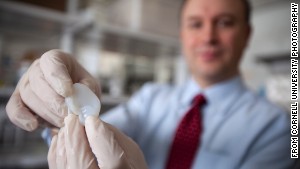
Lawrence Bonassar, a professor of biomedical engineering at Cornell
University, with an artificial ear made via 3-D printing and injectable
molds.
The idea of printing a
human kidney or liver in a lab may seem incomprehensible, even creepy.
But to many scientists in the field, bioprinting holds great promise.
Authentic printed organs could be used for drug or vaccine testing,
freeing researchers from less accurate methods such as tests on animals
or on synthetic models.
Bioprinting works like
this: Scientists harvest human cells from biopsies or stem cells, then
allow them to multiply in a petri dish. The resulting mixture, a sort of
biological ink, is fed into a 3-D printer, which is programmed to
arrange different cell types, along with other materials, into a precise
three-dimensional shape. Doctors hope that when placed in the body,
these 3-D-printed cells will integrate with existing tissues.
The process already is seeing some success. Last year a 2-year-old girl in Illinois, born without a trachea, received a windpipe built with her own stem cells. The U.S. government has funded a university-led "body on a chip" project
that prints tissue samples that mimic the functions of the heart,
liver, lungs and other organs. The samples are placed on a microchip and
connected with a blood substitute to keep the cells alive, allowing
doctors to test specific treatments and monitor their effectiveness.
"This is an exciting new
area of medicine. It has the potential for being a very important
breakthrough," said Dr. Jorge Rakela, a gastroenterologist at the Mayo
Clinic in Phoenix and a member of the American Liver Foundation's medical advisory committee.
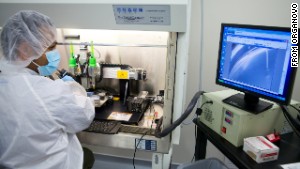
One of Organovo's engineers oversees the construction of a vascular tissue construct on a NovoGen MMX bioprinter.
"Three-D printing allows
you to be closer to what is happening in real life, where you have
multiple layers of cells," he said. With current 2-D models, "if you
grow more than one or two layers, the cells at the bottom suffocate from
lack of oxygen."
To accelerate the development of bioprinted organs, a Virginia foundation that supports regenerative medicine research announced in December it will award a $1 million prize for the first organization to print a fully functioning liver.
One early contender for the prize is Organovo, a California start-up
that has been a leader in bioprinting human body parts for commercial
purposes. Using cells from donated tissue or stem cells, Organovo is
developing what it hopes will be authentic models of human organs,
primarily livers, for drug testing.
The company has printed
strips of human liver tissue in its labs, although they are still very
small: four by four by one millimeter, or about one-fourth the size of a
dime. Each strip takes about 45 minutes to print, and it takes another
two days for the cells to grow and mature, said Organovo CEO Keith
Murphy. The models can then survive for about 40 days.
Organovo has also built models of human kidneys, bone, cartilage, muscle, blood vessels and lung tissue, he said.
"Basically what it
allows you to do is build tissue the way you assemble something with
Legos," Murphy said. "So you can put the right cells in the right
places. You can't just pour them into a mold."
Ethical concerns
Not everyone is comfortable with this bold new future of lab-built body parts, however.
A research director at
Gartner Inc., the information-technology research and advisory firm,
believes 3-D bioprinting is advancing so quickly that it will spark a
major ethical debate by 2016.
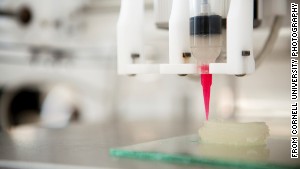
A 3-D printer at Cornell University produces an artificial ear.
"Three-D bioprinting
facilities with the ability to print human organs and tissue will
advance far faster than general understanding and acceptance of the
ramifications of this technology," Pete Basiliere said in a recent report.
"These initiatives are
well-intentioned, but raise a number of questions that remain
unanswered," Basiliere added. "What happens when complex 'enhanced'
organs involving nonhuman cells are made? Who will control the ability
to produce them? Who will ensure the quality of the resulting organs?"
Bioprinted organs are also likely to be expensive, which could put them out of reach of all but the wealthiest patients.
Murphy said Organovo
only uses human cells in creating tissues, and doesn't see any ethical
problems with what his company is doing.
"People used to worry
about doing research on cadavers ... and that dissipated very quickly,"
he said. "We don't think there's any controversy if you're producing
good data and helping people with health conditions."
Most experts, including Wake Forest's Atala,
don't think we'll see complex 3-D-printed organs, suitable for
transplants, for years if not decades. Instead, they believe the next
step will be printing strips of tissue, or patches, that could be used
to repair livers and other damaged organs.
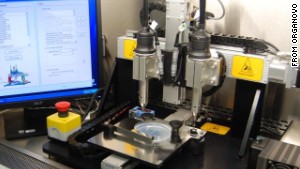
Organovo's NovoGen MMX bioprinter is small enough to fit into a cabinet.
"We are very eager to
put pieces of tissue to work for surgical transplants," said Organovo's
Murphy, who hopes his company will be ready to begin clinical trials
within five years.
Of course, any use of
3-D-printed tissue in surgical procedures would require approval by the
U.S. Food and Drug Administration. That review process could take up to a
decade.
By then, the notion of a
surgeon putting a 3-D-printed kidney into a patient may not seem so
bizarre. Then again, this swiftly evolving technology may create new
moral conundrums.
"The ethical questions
are bound to be the same concerns we have seen in the past. Many major
medical breakthroughs have suffered moral resistance, from organ
transplants to stem cells," said Titsch of 3D Printer World.
"Will only the rich be able to afford it? Are we playing God? In the end, saving lives tends to trump all objections."
For scientist Jack Newman, creating a new life-form has become as simple as this: He types out a DNA sequence on his laptop. Clicks “send.” And a few yards away in the laboratory, robotic arms mix together some compounds to produce the desired cells.
Newman’s biotech company is creating new organisms, most forms of genetically modified yeast, at the dizzying rate of more than 1,500 a day. Some convert sugar into medicines. Others create moisturizers that can be used in cosmetics. And still others make biofuel, a renewable energy source usually made from corn.
Every week, it seems, there’s a new breakthrough in 3-D printing that promises us the ability to (eventually) fabricate some new thing in one of those glass-walled wonder boxes. Such things have included everything from spare parts for the International Space Station above to the beef on our dinner plates to the organs inside our bodies. Although this last idea of fabricating body parts may seem the most fanciful, a team of scientists is reporting a breakthrough in 3-D printing using human embryonic stem cells that could purportedly lead to life-like bioengineered tissue and, eventually, artificial organs tailor-made for specific patients.
Researchers have been able to engineer tissue samples in the past by combining artificial scaffold-like structures and animal cells. Depositing human embryonic stem cells in cultures using a 3-D printer offers some advantages. In particular, the cells can be positioned in droplets of uniform size cheaper, faster and more easily than using manual methods. This uniformity is important for researchers trying to generate specific cell types.
Image of 3-D cell printer courtesy of Colin Hattersley
Whereas human embryonic stem cells have proved too fragile to print in the past, scientists at Scotland’s Heriot-Watt University and Roslin Cellab, a stem cell technology company, say they have developed a new technique that allowed them to deposit droplets of a consistent size containing living cells that survived the process and maintained their ability to develop into different types of mature cells. The research will be published Tuesday in the journal Biofabrication.
In the 3-D printing process, generally a nozzle resembling an inkjet deposits thin layers of resin or a polymer that hardens—either naturally or after being sintered by a laser—into a particular structure. So-called “bioprinters” naturally use cells rather than plastics to create organic structures. However, this technique can damage the printed cells, so the Heriot-Watt and Roslin Cellab scientists developed a printing system driven by pneumatic pressure and controlled by the opening and closing of a microvalve. The researchers could precisely control the amount of cells dispensed by changing the nozzle diameter, the inlet air pressure or the opening time of the valve.
The scientists acknowledge that other researchers have in the past printed mouse embryonic stem cells and even certain types of human stem cells. Human embryonic stem cells, although more sensitive to physical manipulation, can generate a wider variety of specific cell types than other forms of human stem cells. In addition, any tissue formed would yield better models of human biology than those formed from mouse cells.
The use of embryonic stem cells has been a source of controversy particularly in the United States. Last month the US Supreme Court ended an effort to shut down government support of human embryonic stem cell research by refusing to hear a case that challenged the legality of funding for the work by the National Institutes of Health (NIH). This means NIH-funded researchers can continue to work with the 195 new human embryonic stem cell lines the federal government has made available to them.
Despite the success reported by the Scottish scientists, 3-D-printed organs are still decades away from reality. Unlike the skin and muscle tissue that some researchers have successfully fabricated in the lab, solid organs such as the liver, kidney and heart require complex vascular structures that allow them to absorb nutrients and discard waste. Researchers at the University of Pennsylvania’s Tissue Microfabrication Laboratory, the Wake Forest Institute for Regenerative Medicine and elsewhere are developing methods for bioengineering functional vessels that could someday be used to ferry blood around 3-D-printed organs.
A more immediate benefit of 3-D printing embryonic stem cells might be the ability to make tissue samples that could be used to accurately test drug compounds for toxicity in humans, without the need for animal testing, according to the researchers.
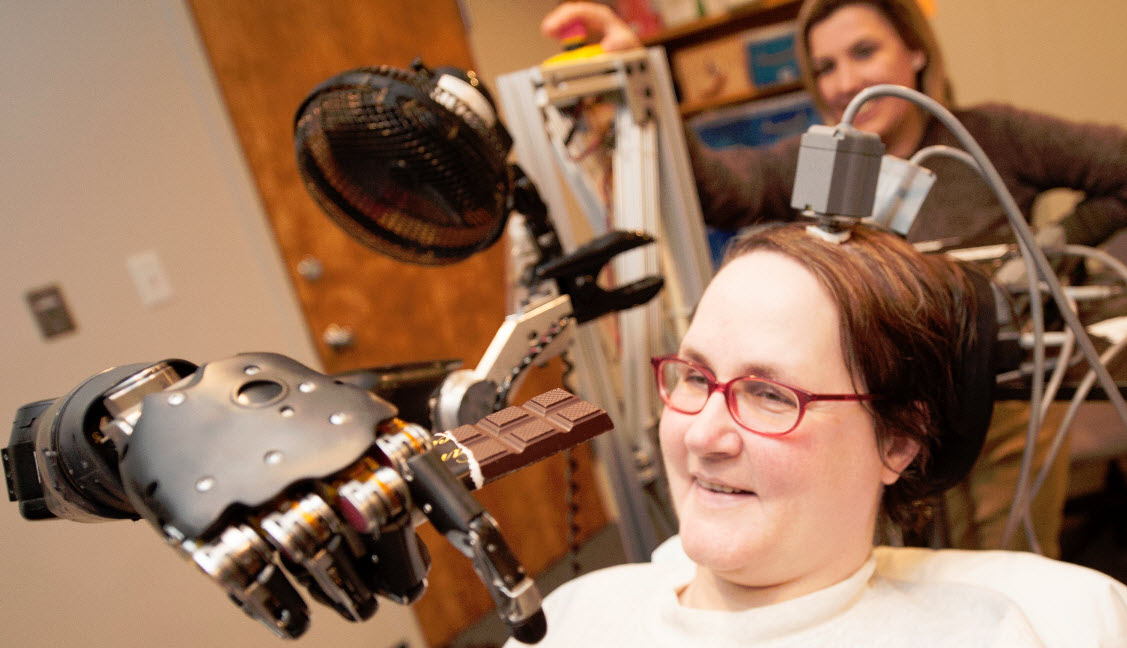
Jan Scheuermann, who has quadriplegia, brings a chocolate bar to her mouth using a robot arm she is guiding with her thoughts, while researcher Elke Brown, M.D., watches in the background (credit: UPMC)
Reaching out to “high five” someone, grasping and moving objects of different shapes and sizes, feeding herself dark chocolate.
For Jan Scheuermann and a team of researchers from the University of Pittsburgh School of Medicine and UPMC, accomplishing these seemingly ordinary tasks demonstrated for the first time that a person with longstanding quadriplegia can maneuver a mind-controlled, human-like robot arm in seven dimensions (7D) to consistently perform many of the natural and complex motions of everyday life.
In a study published in the online version of The Lancet, the researchers described the brain-computer interface (BCI) technology and training programs that allowed Ms. Scheuermann, 53, to intentionally move an arm, turn and bend a wrist, and close a hand for the first time in nine years.
Less than a year after she told the research team, “I’m going to feed myself chocolate before this is over,” Ms. Scheuermann savored its taste and announced as they applauded her feat, “One small nibble for a woman, one giant bite for BCI.”
“This is a spectacular leap toward greater function and independence for people who are unable to move their own arms,” agreed senior investigator Andrew B. Schwartz, Ph.D., professor, Department of Neurobiology, Pitt School of Medicine. “This technology, which interprets brain signals to guide a robot arm, has enormous potential that we are continuing to explore. Our study has shown us that it is technically feasible to restore ability; the participants have told us that BCI gives them hope for the future.”
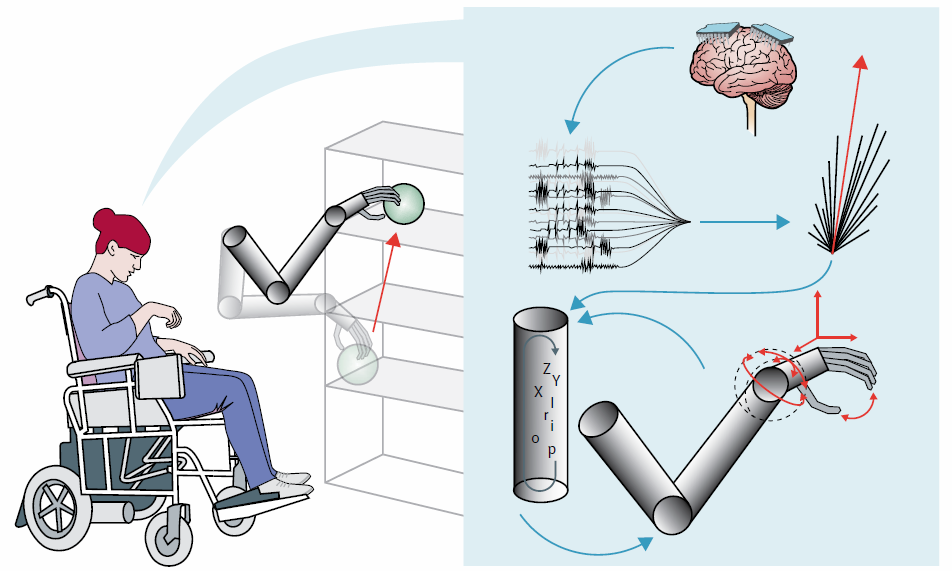
On Feb. 10, 2012, after screening tests to confirm that she was eligible for the study, co-investigator and UPMC neurosurgeon Elizabeth Tyler-Kabara, M.D., Ph.D., assistant professor, Department of Neurological Surgery, Pitt School of Medicine, placed two quarter-inch square electrode grids with 96 tiny contact points each in the regions of Ms. Scheuermann’s brain that would normally control right arm and hand movement.
The electrode points pick up signals from individual neurons and computer algorithms are used to identify the firing patterns associated with particular observed or imagined movements, such as raising or lowering the arm, or turning the wrist, explained lead investigator Jennifer Collinger, Ph.D., assistant professor, Department of Physical Medicine and Rehabilitation (PM&R), and research scientist for the VA Pittsburgh Healthcare System. That intent to move is then translated into actual movement of the robot arm, which was developed by Johns Hopkins University’s Applied Physics Lab.
Two days after the operation, the team hooked up the two terminals that protrude from Ms. Scheuermann’s skull to the computer. “We could actually see the neurons fire on the computer screen when she thought about closing her hand,” Dr. Collinger said. “When she stopped, they stopped firing. So we thought, ‘This is really going to work.’”
7D control
How the neuroprosthetic system works. Two silicon-substrate microelectrode arrays surgically implanted in the motor cortex (upper right) allow recordings of ensemble neuronal activity, which are then translated into intended movement commands. This brain-derived information is conveyed to a shared controller that integrates the participant’s intent, robotic position feedback, and task-dependent constraints. Using this bioinspired brain-machine interface, the paralyzed woman could manipulate objects of various shapes and sizes in a 3D workspace. (Credit: Jennifer L Collinger et al./The Lancet)
Within a week, Ms. Scheuermann could reach in and out, left and right, and up and down with the arm, which she named Hector, giving her 3-dimensional control that had her high-fiving with the researchers. “What we did in the first week they thought we’d be stuck on for a month,” she noted.
Before three months had passed, she also could flex the wrist back and forth, move it from side to side and rotate it clockwise and counter-clockwise, as well as grip objects, adding up to what scientists call 7D control.
In a study task called the Action Research Arm Test, Ms. Scheuermann guided the arm from a position four inches above a table to pick up blocks and tubes of different sizes, a ball and a stone and put them down on a nearby tray. She also picked up cones from one base to restack them on another a foot away, another task requiring grasping, transporting and positioning of objects with precision.
“Our findings indicate that by a variety of measures, she was able to improve her performance consistently over many days,” Dr. Schwartz explained. “The training methods and algorithms that we used in monkey models of this technology also worked for Jan, suggesting that it’s possible for people with long-term paralysis to recover natural, intuitive command signals to orient a prosthetic hand and arm to allow meaningful interaction with the environment.”
Electrocortigraphy (ECoG) study
In a separate study, researchers also continue to study BCI technology that uses an electrocortigraphy (ECoG) grid, which sits on the surface of the brain rather than slightly penetrates the tissue as in the case of the grids used for Ms. Scheuermann.
In both studies, “we’re recording electrical activity in the brain, and the goal is to try to decode what that activity means and then use that code to control an arm,” said senior investigator Michael Boninger, M.D., professor and chair, PM&R, and director of UPMC Rehabilitation Institute. “We are learning so much about how the brain controls motor activity, thanks to the hard work and dedication of our trial participants. Perhaps in five to 10 years, we will have a device that can be used in the day-to-day lives of people who are not able to use their own arms.”
The next step for BCI technology will likely use a two-way electrode system that can not only capture the intention to move, but in addition, will stimulate the brain to generate sensation, potentially allowing a user to adjust grip strength to firmly grasp a doorknob or gently cradle an egg.
After that, “we’re hoping this can become a fully implanted, wireless system that people can actually use in their homes without our supervision,” Dr. Collinger said. “It might even be possible to combine brain control with a device that directly stimulates muscles to restore movement of the individual’s own limb.”
For now, Ms. Scheuermann is expected to continue to put the BCI technology through its paces for two more months, and then the implants will be removed in another operation.
“This is the ride of my life,” she said. “This is the rollercoaster. This is skydiving. It’s just fabulous, and I’m enjoying every second of it.”
The BCI projects are funded by the Defense Advanced Research Projects Agency, National Institutes of Health, the U.S. Department of Veteran’s Affairs, the UPMC Rehabilitation Institute and the University of Pittsburgh Clinical and Translational Science Institute.
For more information about participating in the trials, call 412-383-1355.
How this compares to previous studies
The results of previous work have shown that neural activity can be recorded from the motor cortex and translated to movement of an external device or the individual’s own muscles, the authors say. However, until now, the results of human studies have not shown whether the natural and complex movements can be done consistently for different tasks.
“Here, we have shown that a person with chronic tetraplegia can do complex and coordinated movements freely in seven-dimensional space consistently over several weeks of testing. This study is different from previous studies in which investigators had little control in translation dimensions, used staged control schemes, or had insufficient workspace to complete very structured tasks.
“Increasing dimensional control allows our participant to fully explore the workspace by placing the hand in the desired three-dimensional location and orienting the palm in three dimensions. This study is the first time that performance has been quantified with functional clinical assessments. Although in most human studies only a few days of performance data were reported, we have shown that the participant learned to improve her performance consistently over many days using different metrics.
“By using training methods and algorithms validated in non-human primate work, individuals with long-term paralysis can recover the natural and intuitive command signals for hand placement, orientation, and reaching to move freely in space and interact with the environment.”
The RSC web site features an article on molecular machines written by
Josh Howgego that gives a very good brief introduction to the topic: Rise of the molecular machines. A downloadable PDF of the article as it originally appeared in Education in Chemistry
provides better images of the figures than does the HTML version. The
article explains how chemists have worked to mimic the function of
biological molecular machine like muscles, by using intermolecular
forces to control movements of mechanically interlocked molecules. The
first example given is from the work of Fraser Stoddart, winner of the 2007 Feynman Prizes in Nanotechnology for Experimental work and Co-Chair of the January 2013 Foresight Technical Conference: Illuminating Atomic Precision, which will feature a session
on “Molecular Machines and Non-Equilibrium Processes,” which Prof.
Stoddart will chair. The article goes on to explain that harnessing
simple molecular shuttles of the type pioneered by Stoddart to do real
work like muscles has proved difficult, and cites as a prototype
solution a molecular machine that works in a different way: a walker
that sequentially makes and breaks different types of covalent bonds,
developed by David Leigh, winner of the 2007 Feynman Prizes in Nanotechnology
in the Theory category. The article finishes with a description of a
nanocar developed by Ben Feringa that uses electricity to move across a
metal surface by rotating paddle-like wheels.
NEW YORK — Scientists reported Sunday that they have completed a major analysis of the genetics of breast cancer, finding four major classes of the disease. They hope their work will lead to more effective treatments, perhaps with some drugs already in use.
The new finding offers hints that one type of breast cancer might be vulnerable to drugs that already work against ovarian cancer.
The study, published online Sunday by the journal Nature, is the latest example of research into the biological details of tumors, rather than focusing primarily on where cancer arises in the body.
The hope is that such research can reveal cancer's genetic weaknesses for better drug targeting.
"With this study, we're one giant step closer to understanding the genetic origins of the four major subtypes of breast cancer," Dr. Matthew Ellis of the Washington University School of Medicine said in a statement. He is a co-leader of the research.
"Now we can investigate which drugs work best for patients based on the genetic profiles of their tumors," he said.
The researchers analyzed DNA of breast cancer tumors from 825 patients, looking for abnormalities. Altogether, they reported, breast cancers appear to fall into four main classes when viewed in this way.
One class showed similarities to ovarian cancers, suggesting it may be driven by similar biological developments.
"It's clear they are genetically more similar to ovarian tumors than to other breast cancers," Ellis said. "Whether they can be treated the same way is an intriguing possibility that needs to be explored."
The report is the latest from the Cancer Genome Atlas, a federally funded project that has produced similar analyses for brain, colorectal, lung, and ovarian cancers.
¨Saturno jugando con sus hijos¨/ Pedro Pablo Oliva
Seguidores
Carta desde la carcel de Fidel Castro Ruz
“…después de todo, para mí la cárcel es un buen descanso, que sólo tiene de malo el que es obligatorio. Leo mucho y estudio mucho. Parece increíble, las horas pasan como si fuesen minutos y yo, que soy de temperamento intranquilo, me paso el día leyendo, apenas sin moverme para nada. La correspondencia llega normalmente…”
“…Como soy cocinero, de vez en cuando me entretengo preparando algún pisto. Hace poco me mandó mi hermana desde Oriente un pequeño jamón y preparé un bisté con jalea de guayaba. También preparo spaghettis de vez en cuando, de distintas formas, inventadas todas por mí; o bien tortilla de queso. ¡Ah! ¡Qué bien me quedan! por supuesto, que el repertorio no se queda ahí. Cuelo también café que me queda muy sabroso”. “…En cuanto a fumar, en estos días pasados he estado rico: una caja de tabacos H. Upman del doctor Miró Cardona, dos cajas muy buenas de mi hermano Ramón….”. “Me voy a cenar: spaghettis con calamares, bombones italianos de postre, café acabadito de colar y después un H. Upman #4. ¿No me envidias?”. “…Me cuidan, me cuidan un poquito entre todos. No le hacen caso a uno, siempre estoy peleando para que no me manden nada. Cuando cojo el sol por la mañana en shorts y siento el aire de mar, me parece que estoy en una playa… ¡Me van a hacer creer que estoy de vacaciones! ¿Qué diría Carlos Marx de semejantes revolucionarios?”.
Quotes
¨La patria es dicha de todos, y dolor de todos, y cielo para todos, y no feudo ni capellanía de nadie¨ - Marti
"No temas ni a la prision, ni a la pobreza, ni a la muerte. Teme al miedo" - Giacomo Leopardi
¨Por eso es muy importante, Vicky, hijo mío, que recuerdes siempre para qué sirve la cabeza: para atravesar paredes¨– Halvar de Flake[El vikingo]
"Como no me he preocupado de nacer, no me preocupo de morir"- Lorca
"Al final, no os preguntarán qué habéis sabido, sino qué habéis hecho" - Jean de Gerson
"Si queremos que todo siga como está, es necesario que todo cambie" - Giuseppe Tomasi di Lampedusa
"Todo hombre paga su grandeza con muchas pequeñeces, su victoria con muchas derrotas, su riqueza con múltiples quiebras" - Giovanni Papini
"Life is what happens while you are busy making other plans" - John Lennon
"Habla bajo, lleva siempre un gran palo y llegarás lejos" - Proverbio Africano
"No hay medicina para el miedo"-Proverbio escoces "El supremo arte de la guerra es doblegar al enemigo sin luchar" -Sun Tzu
"You do not really understand something unless you can explain it to your grandmother" - Albert Einstein
"It is inaccurate to say I hate everything. I am strongly in favor of common sense, common honesty, and common decency. This makes me forever ineligible for public office" - H. L. Menken
"I swore never to be silent whenever and wherever human beings endure suffering and humiliation. We must always take sides. Neutrality helps the oppressor, never the victim. Silence encourages the tormentor, never the tormented" -Elie Wiesel
"Stay hungry, stay foolish" - Steve Jobs
"If you put the federal government in charge of the Sahara Desert , in five years ther'ed be a shortage of sand" - Milton Friedman
"The tragedy of modern man is not that he knows less and less about the meaning of his own life, but that it bothers him less and less" - Vaclav Havel
"No se puede controlar el resultado, pero si lo que uno haga para alcanzarlo" - Vitor Belfort [MMA Fighter]
Liborio
A la puerta de la gloria está San Pedro sentado y ve llegar a su lado a un hombre de cierta historia. No consigue hacer memoria y le pregunta con celo: ¿Quién eras allá en el suelo? Era Liborio mi nombre. Has sufrido mucho, hombre, entra, te has ganado el cielo.
Para Raul Castro
Cuba ocupa el penultimo lugar en el mundo en libertad economica solo superada por Corea del Norte.
Cuba ocupa el lugar 147 entre 153 paises evaluados en "Democracia, Mercado y Transparencia 2007"
Cuando vinieron a buscar a los comunistas, Callé: yo no soy comunista. Cuando vinieron a buscar a los sindicalistas, Callé: yo no soy sindicalista. Cuando vinieron a buscar a los judíos, Callé: yo no soy judío. Cuando vinieron a buscar a los católicos, Callé: yo no soy “tan católico”. Cuando vinieron a buscarme a mí, Callé: no había quien me escuchara.
Un sitio donde los hechos y sus huellas nos conmueven o cautivan
CUBA LLORA Y EL MUNDO Y NOSOTROS NO ESCUCHAMOS
Donde esta el Mundo, donde los Democratas, donde los Liberales? El pueblo de Cuba llora y nadie escucha. Donde estan los Green, los Socialdemocratas, los Ricos y los Pobres, los Con Voz y Sin Voz? Cuba llora y nadie escucha. Donde estan el Jet Set, los Reyes y Principes, Patricios y Plebeyos? Cuba desesperada clama por solidaridad. Donde Bob Dylan, donde Martin Luther King, donde Hollywood y sus estrellas? Donde la Middle Class democrata y conservadora, o acaso tambien liberal a ratos? Y Gandhi? Y el Dios de Todos? Donde los Santos y Virgenes; los Dioses de Cristianos, Protestantes, Musulmanes, Budistas, Testigos de Jehova y Adventistas del Septimo Dia. Donde estan Ochun y todas las deidades del Panteon Yoruba que no acuden a nuestro llanto? Donde Juan Pablo II que no exige mas que Cuba se abra al Mundo y que el Mundo se abra a Cuba? Que hacen ahora mismo Alberto de Monaco y el Principe Felipe que no los escuchamos? Donde Madonna, donde Angelina Jolie y sus adoptados around de world; o nos hara falta un Brando erguido en un Oscar por Cuba? Donde Sean Penn? Donde esta la Aristocracia Obrera y los Obreros menos Aristocraticos, donde los Working Class que no estan junto a un pueblo que lanquidece, sufre y llora por la ignominia? Que hacen ahora mismo Zapatero y Rajoy que no los escuchamos, y Harper y Dion, e Hillary y Obama; donde McCain que no los escuchamos? Y los muertos? Y los que estan muriendo? Y los que van a morir? Y los que se lanzan desesperados al mar? Donde estan el minero cantabrico o el pescador de percebes gijonese? Los Canarios donde estan? A los africanos no los oimos, y a los australianos con su acento de hombres duros tampoco. Y aquellos chinos milenarios de Canton que fundaron raices eternas en la Isla? Y que de la Queen Elizabeth y los Lords y Gentlemen? Que hace ahora mismo el combativo Principe Harry que no lo escuchamos? Donde los Rockefellers? Donde los Duponts? Donde Kate Moss? Donde el Presidente de la ONU? Y Solana donde esta? Y los Generales y Doctores? Y los Lam y los Fabelo, y los Sivio y los Fito Paez? Y que de Canseco y Miñoso? Y de los veteranos de Bahia de Cochinos y de los balseros y de los recien llegados? Y Carlos Otero y Susana Perez? Y el Bola, y Pancho Cespedes? Y YO y TU? Y todos nosotros que estamos aqui y alla rumiando frustaciones y resquemores, envidias y sinsabores; autoelogios y nostalgias, en tanto Louis Michel comulga con Perez Roque mientras Biscet y una NACION lanquidecen? Donde Maceo, donde Marti; donde aquel Villena con su carga para matar bribones? Cuba llora y clama y el Mundo NO ESCUCHA!!!








![NEOCASTRISMO [Hacer click en la imagen]](http://4.bp.blogspot.com/_5jy0SZhMlaU/SsuPVOlq2NI/AAAAAAAAH1E/4xt2Bwd2reE/S150/ppo+saturno+jugando+con+sus+hijos.jpg)


