CONTRA EL PINGALISMO CASTRISTA/ "Se que no existe el consuelo que no existe la anhelada tierrra de mis suenos ni la desgarrada vision de nuestros heroes. Pero te seguimos buscando, patria,..." - Reinaldo Arenas
jueves, enero 20, 2011
El Ejército colombiano abate a «Didier», cabecilla de las FARC
#Cuba "Boleto al paraíso" o los jovenes que se infestaron de #Sida
Hawaii governor can't find Obama birth certificate
BORN IN THE USA?
Hawaii governor can't find Obama birth certificate
Suggests controversy could hurt president's re-election chances
Posted: January 18, 2011
8:05 pm Eastern
By Jerome R. Corsi
© 2011 WorldNetDaily
![]() Neil Abercrombie |
Donalyn Dela Cruz, Abercrombie's spokeswoman in Honolulu, ignored again today another in a series of repeated requests made by WND for an interview with the governor.
Toward the end of the interview, the newspaper asked Abercrombie: "You stirred up quite a controversy with your comments regarding birthers and your plan to release more information regarding President Barack Obama's birth certificate. How is that coming?"
In his response, Abercrombie acknowledged the birth certificate issue will have "political implications" for the next presidential election "that we simply cannot have."
Get the free, in-depth special report on eligibility that could bring an end to Obama's presidency
Suggesting he was still intent on producing more birth records on Obama from the Hawaii Department of Health vital records vault, Abercrombie told the newspaper there was a recording of the Obama birth in the state archives that he wants to make public.
(Story continues below)
| | |
"It was actually written, I am told, this is what our investigation is showing, it actually exists in the archives, written down," Abercrombie said.
For seemingly the first time, Abercrombie frankly acknowledged that presidential politics motivated his search for Obama birth records, implying that failure to resolve the questions that remain unanswered about the president's birth and early life may damage his chance for re-election.
"If there is a political agenda (regarding Obama's birth certificate), then there is nothing I can do about that, nor can the president," he said.
So far, the only birth document available on Obama is a Hawaii Certification of Live Birth that first appeared on the Internet during the 2008 presidential campaign. It was posted by two purportedly independent websites that have displayed a strong partisan bias for Obama – Snopes.com released the COLB in June 2008, and FactCheck.org published photographs of the document in August 2008.
WND previously reported the Hawaii Department of Health has refused to authenticate the COLB posted on the Internet by Snopes.com and FactCheck.org.
WND has reported that in 1961, Obama's grandparents, Stanley and Madelyn Dunham, could have made an in-person report of a Hawaii birth even if the infant Barack Obama Jr. had been foreign-born.
Similarly, the newspaper announcements of Obama's birth do not prove he was born in Hawaii, since they could have been triggered by the grandparents registering the birth as Hawaiian, even if the baby was born elsewhere.
Moreover, WND has documented that the address reported in the newspaper birth announcements was the home of the grandparents.
WND also has reported that Barack Obama Sr. maintained his own separate apartment in Honolulu, even after he was supposedly married to Ann Dunham, Barack Obama's mother, and that Dunham left Hawaii within three weeks of the baby's birth to attend the University of Washington in Seattle.
Dunham did not return to Hawaii until after Barack Obama Sr. left Hawaii in June 1962 to attend graduate school at Harvard University in Cambridge, Mass.
Conceivably, the yet undisclosed birth record in the state archives that Abercrombie has discovered may have come from the grandparents registering Obama's birth, an event that would have triggered both the newspaper birth announcements and availability of a Certification of Live Birth, even if no long-form birth certificate existed.
WND has also reported that Tim Adams, a former senior elections clerk for the city and county of Honolulu in 2008, has maintained that there is no long-form, hospital-generated birth certificate on file with the Hawaii Department of Health and that neither Honolulu hospital – Queens Medical Center or Kapiolani Medical Center – has any record that Obama was born there.
Read more: Hawaii governor can't find Obama birth certificate http://www.wnd.com/?pageId=252833#ixzz1BcCJ1G6G
The Castro Mafia’s ties to Medicare Fraud in Florida
No doubt about it.
Babalu Blog: An island on the airwaves without a bearded dictator
The Castro Mafia’s ties to Medicare Fraud in Florida
The Cuban Government and Multi-Million Dollar Medicare Fraud in South Florida
The dilapidated state of the Cuban economy has left the Cuban government scrambling for ways to obtain hard currency. Cuba has contrived ways to benefit from leasing doctors, nurses, teachers, and security agents abroad; more recently, Cuba has also found ways to capitalize on large-scale Medicare fraud, possibly committing economic warfare on the United States.Medicare fraud is one of the highest dollar volume crimes in the United States. In October of 2009, it was estimated that such fraud has reached $60 billion a year. (1) And South Florida has become the epicenter of this federal crime.
[...]
The question should be posed: What makes South Florida different from any other region and can account for the troubling number of fraudulent claims emanating from the area?
Given that “at least half of South Florida’s Medicare fugitives are believed to be [hiding] in Cuba,” it is probable that the region’s Cuban-connections can be playing a significan
RICKY GERVAIS will go into hiding in Cuba
CONTROVERSIAL comic RICKY GERVAIS will go into hiding in Cuba, if his girlfriend gets her way.
The British funny man stunned fans and celebrities recently with a string of risque comments at this weekend's Golden Globes.And the Office legend's long-term partner JANE FALLON has already hatched an escape plan in case the fall out gets any worse.
In an interview with PIERS MORGAN, Ricky revealed: "She said, I've got the fast car.
"Here's the disguise and I have two tickets to Cuba."
But the comic is determined not to go into exile.
He continued: "It's not my job to worry about what people think of me, that's the job of a politician. I don't care what people think of me.
"They hired me for a job and if they didn't want me, they shouldn't have hired me."
He added: "I'm sorry if they were offended but I'm not sorry for anything I said."
Jokes at the glittering bash included a dig at Iron Man ROBERT DOWNEY JR for his stints in jail and rehab
He introduced him saying: "Many of you in this room probably know him best from such facilities as the Betty Ford Clinic and Los Angeles County Jail."
Ricky also ridiculed flop The Tourist, with JOHNNY DEPP and ANGELINA JOLIE, adding it only qualified for awards as organisers, the Hollywood Foreign Press Association, "accepted bribes".
BE CAREFUL WITH CHOCOLATE...
THIS IS THE RESULT
WikiCuba: Brasil cree que régimen de Cuba es "insostenible"
WikiLeaks: Brasil cree que régimen de Cuba es "insostenible"
CONSEJO PARA EL 2011/ Humor
miércoles, enero 19, 2011
Capital's war against #WikiLeaks
Long famed for hiding money for everyone from Nazis and drug lords to spies and dictators, the Swiss government's banking arm has decided that WikiLeaks and Julian Assange are just too hot even for it to handle.
And so the PostFinance, which runs the country's banks, declared in early December that it had "ended its business relationship with WikiLeaks founder Julian Paul Assange" after accusing Mr. Assange of - gasp! - providing false information about his place of residence.
This move followed similar moves by credit card companies MasterCard and Visa, as well as PayPal and Amazon.com, to no longer process WikiLeaks payments and, in Amazon.com's case, to cease hosting its data.
As I write this, Bank of America has joined the crescendo of corporations taking aim at WikiLeaks, refusing to process payments for it any longer because of "our reasonable belief that WikiLeaks may be engaged in activities that are, among other things, inconsistent with our internal policies for processing payments."
And soon after, none other than Apple joined the chorus, pulling the plug on a WikiLeaks app only days after it went on sale on its iTunes website. Every sector of the corporate economy, it seems, is out to get WikiLeaks.
Zeroing in on "neocorporatism"
Should CIA agents, mafia bosses and other fellow Swiss banking customers who have likely been even less than forthright in their personal representations than Assange is alleged to have been also worry about the loyalty and discretion of their Swiss bankers?
Probably not. And that's because the world's criminals, autocrats and spooks are very much part of the global political economic system, even if sometimes on opposite sides.
But WikiLeaks both operates outside the system, seeking "Matrix"-style, to use technology - the internet - to "destroy" it by prying it open to public scrutiny, exposing the constant conspiracies of the powerful against the rest of society.
This task, Assange argues, is the most important way to help free the system's millions of often complicit - if not quite willing - victims and in so doing, "change or remove... government and neocorporatist behaviour".
As a political theorist, Assange leaves something to be desired. "Neocorporatism" describes a system in which capital and labour are enmeshed in an integrated but ultimately dependent relationship with a powerful and autonomous state apparatus - an update of the triangular relationship that enabled unprecedented economic growth and gains for the working class in the West in the decades after World War II.
Ideologically, this kind of close working relationship between government, big business and organised labour is the antithesis of the neoliberal system WikiLeaks seeks to combat.
But Assange is right that there is something "neo", if not exactly new, in the way the corporate sector is behaving today and its relationship with government. It lies in the embrace - or better, re-embrace - of finance capitalism and militaristic empire and the military industrial complex that sustains it.
Whether preying on unwitting consumers in middle America or preying on suspected insurgents in the Middle East, these are two of the most secretive sectors of the American economy. They depend on the public knowing as little as possible about their inner workings to secure the greatest possible freedom of action, power and profits.
The power of secrecy
Assage's abandonment by the Swiss banking system and its American corporate cousins is thus not surprising. Few industries have used secrecy and lack of disclosure more effectively than the banking, financial services and credit card industries.
Indeed, their secretive business practises are central to their constant ability to rake in enormous profits at the expense of working and middle class Americans through monopolising trading systems, charging morally usurious interest rates and fees, and engaging in other practises that would make even the most cold-hearted lone shark blush.
If the grand bargain between workers, capitalists and governments enabled the first two post-World War II generations to move from high school right into the middle class, this road was irreparably damaged by the 1980s, when the neoliberal Right first came to power.
As the United States entered its long and painful era of deindustrialization American foreign policy became more aggressively militaristic; and so joining the military as opposed to GM or Ford became one of the few routes to secure any kind of stable economic future (as long as you stayed in the military).
Not surprisingly, profits from the financial sector surpassed that of manufacturing in the early 1990s and haven't dropped since. But these profits and the economic growth they generated have relied disproportionately on government and consumer debt and a hollowing out of the manufacturing sector, which together helped make the US the "sick man of the globe", as one senior corporate economist.
For their part, GM, Ford and Chrysler simultaneously focused most of their energies on producing comparatively profitable gas-guzzlers like SUVs while establishing financial services arms that quickly became responsible for a substantial share of their profits (in some years upwards of 90 percent of profits are so derived).
Their lending practises, it's worth noting, included the kinds of "liar" home loans, given out with little concern over the ability of borrowers to pay them, that precipitated the global economic crisis of 2007 till today.
Financialisation and history
None of these practises would have withstood the light of public scrutiny, and it was only the corporatisation - in good measure, financialization - of American politics that allowed them to flourish in the last thirty years. Few enterprises threaten that secrecy as much as WikiLeaks and its laser-like focus on openness, which is why its actions are viewed in Washington as "striking at the very heart of the global economy".
The "financialisation" of the economy represents the increasing dominance of the financial industries in the overall economy, taking over "the dominant economic, cultural, and political role in a national economy".
Crucially, this process isn't unique to the United States; it also happened to previous empires, like the Hapsburg's, Dutch and British empires, at precisely the eras they lost their dominant global position. In all cases, financialism and militarism went hand in hand, as first pointed out by the British historian John Hobson's famous 1902 book Imperialism: A Study.
In it, Hobson argued that the monopolisation of the financial sector created a new oligarchy that linked together the large banks and industrial firms together with "war mongers and speculators" which encouraged imperialism to secure markets for the surplus products produced by corporations.
America's rise to global dominance came after the end of the imperial era and so it couldn't blatantly conquer territory to create new markets. But at the moment of its rise policy makers called on the government to use high military spending to ensure overall robust economic growth.
This coincided with rapid expansion of easily obtainable credit, creating two "giant black holes" (in the words of Israeli economists Shimshon Bichler and Jonathan Nitzan) whose potential for expansion was limited only by the willingness of citizens to support the policies that enabled them, despite the long term harm to the economic and political well-being of their societies.
During the first thirty years of the Cold War era, the propensity towards militarism was balanced by the robust manufacturing economy and the tripartite business-labour-government relationship that secured it.
This began to change in the 1970s, when the hugely expensive, and profitable, Vietnam War began to wind down.
As Nitzan and Bichler describe in their hugely important book, The Global Political Economy of Israel, beginning in this period "there was a growing convergence of interests between the world's leading petroleum and armament corporations. The politicisation of oil, together with the parallel commercialisation of arms exports, helped shape an uneasy weapondollar-petrodollar coalition between these companies."
What is most crucial about Nitzan and Bichler's analysis is that one of the most important ways that the arms and oil industries were able to earn a disproportionate (as they describe it, "differential") level of profits was through the regular eruption of Middle Eastern energy conflicts, which ensured both relative high oil prices and arms purchases.
McDonald's and McDonnell Douglas
As this process developed, the authors explain that "the lines separating state from capital, foreign policy from corporate strategy, and territorial conquest from differential profit, no longer seem very solid."
New York Times columnist Thomas Friedman puts it more colourfully: "The hidden hand of the market will never work without the hidden fist. McDonald's cannot flourish without McDonnell Douglas - and the hidden fist that keeps the world safe for Silicon Valley's technologies to flourish is called the US Army, Air Force, Navy, and Marine Corps."
This is the "neocorporatism" that Assange and his WikiLeaks comrades have zeroed in on, although today, more than a decade after Friedman wrote the above words, Master Card is more relevant than McDonald's.
The problem is that WikiLeaks alone cannot turn the tide in this conflict.
Assange might well be a "high tech terrorist," as US Vice President Joseph Biden recently called him, given how much terror his actions have struck in the heart of the American political system.
But the US is ultimately only one of a group of powerful countries and corporations whose leaders all share a fundamental commitment to securing as much profit and power as possible for themselves, however much their methods and politics differ.
Indeed, a sober look at the relevant data reveals that the profit share of the financial sectors outside the US has almost always been significantly higher than in the US, meaning that the rest of the world has long been more "financialised" than has the US economy.
As always, capitalism and power have never been as conveniently centred in one country or region as people imagine.
To really have an impact, WikiLeaks needs to inspire a whole generation of leakers in other countries and cultures, who are as willing to risk their freedom as Assange and the other people behind WikiLeaks. The leak culture has started to take root, however only time will tell if it resists the forces working against it's development.
If this doesn't happen - if Assange and his comrades are successfully made into examples by their corporate and political enemies that scare off those who might be inspired by their example - Capital will likely win the world's first "cyber-war", much as it's won most every war before it during modernity's long, bloody and unimaginably profitable history.
Mark Levine is a professional musician and professor of Middle Eastern history at the University of California, Irvine.
Banking secrets handed to WikiLeaks [Hum!]

Rudolf Elmer, an ex-employee of Swiss-based private bank Julius Baer, handed over two CDs containing the data to Julian Assange, the WikiLeaks founder, at a press conference in London on Monday.
The disks are thought to contain details of 2,000 individuals.
Elmer has said the information includes details on politicians, multinational companies and financial institutions from the United States, Europe and Asia, all secretly avoiding paying tax.
"I do think as a banker I have the right to stand up if something is wrong," Elmer said, addressing reporters at London's Frontline Club, alongside Assange.
"I am against the system. I know how the system works and I know the day-to-day business. From that point of view, I wanted to let society know what I know. It is damaging our society."
Assange promised "full revelation" of the data, but said it would be weeks before any of the information could be checked and published by the WikiLeaks website.
Vetting will be done by Wikileaks, media organisations and other partners in order to protect sources, Assange said.
Banker accused
Elmer, who once headed Julius Baer's offices in the Cayman Islands, previously offered files to WikiLeaks on offshore financial activities in 2007, leading to tax evasion prosecutions in several countries.
He faces a court hearing in Zurich on Wednesday to answer charges of coercion and violating Switzerland's strict banking secrecy laws.
He has said he wants to call attention to offshore financial abuses and promote WikiLeaks as a mechanism for other whistleblowers to air their stories.
But his former employer has hit back, claiming Elmer, who the bank fired in 2002, has other motives.
"After his demands [including financial compensation] in connection with the dismissal could not be satisfied, Mr Elmer embarked in 2004 on a personal intimidation campaign and vendetta against Julius Baer," the bank said in a statement.
"The aim of his activities was and is to discredit Julius Baer as well as clients in the eyes of the public."
Assange, whose website has angered Washington by releasing thousands of leaked US diplomatic cables, is on bail in Britain awaiting Swedish attempts to extradite him for questioning on sexual assault allegations.
Under his bail conditions, the WikiLeaks founder must live at the mansion home of Vaughan Smith, the owner of the Frontline Club.
He has promised the flow of leaked documents will be stepped up.
Swiss banker held over WikiLeaks

Rudolf Elmer arrested over the passing of tax evader details to website, hours after being convicted in separate case.
Elmer was taken into custody on Wednesday evening, having been found guilty by a Zürich court of sharing private client data and of threatening an employee at Julius Baer, his former firm, earlier in the day.
He was arrested on fresh charges of breaching secrecy laws.
"The state prosecutor's office is checking to see whether Rudolf Elmer has violated Swiss banking law by handing the CD over to Wikileaks," the Zürich cantonal (state) police and state prosecutor said in a joint statement.
At a news conference on Monday, Elmer handed data on hundreds of offshore bank accounts to Julian Assange, the WikiLeaks founder.
Prosecutors allege that he stole the information after being fired from his job.
Elmer previously helped to bring WikiLeaks to prominence three years ago when he handed over secret client information to the website.
'Murky oases'
At Wednesday's trial, Elmer admitted sending confidential bank data to tax authorities, but he denied charges of blackmail and a bomb threat against Julius Baer, as alleged by prosecutors.
He also denied taking payments in return for the secret data.
Elmer said he wanted to expose widespread tax evasion by rich businesspeople and politicians when he sent confidential banking files to tax authorities, media and later to WikiLeaks.
"I am a critic of the system and want to tell society what happens in these murky oases," Elmer, who ran the Cayman Islands branch of the Swiss bank, told a news conference before the verdict.
Judge Sebastian Aeppli rejected prosecution demands to give Elmer an eight-month prison sentence for breaching the bank secrecy laws and instead the court sentenced him to a fine of 7,200 Swiss francs ($7,505), suspended for two years
The trial drew broad media attention and about a dozen protesters gathered in front of the court building.
"We think those who expose the distasteful side of Swiss finance need our support," Walter Angst, one of the protesters, said.
Several Swiss banks including UBS, AG and Credit Suisse Group have suffered embarrassing data leaks in recent years, some at the hands of disgruntled employees.
Researchers’ Android Trojan Can “Hear” Credit Card Numbers
Six researchers at Indiana University and the City University of Hong Kong have created a proof-of-concept program called Soundminer (PDF here) that’s capable of using a phone’s mic to listen out for credit card numbers. When a user either speaks or types their credit card’s digits into the phone, Soundminer parses the audio file, interprets the numbers, and sends them to another app that passes them on to a remote server.
Here’s a video of Soundminer in action.
The idea behind the team’s work, which they plan to demonstrate at the Network & Distributed System Security Symposium in San Diego next month, is that a smart user wouldn’t grant an untrusted application access to his or her web browsing or keyboard, where it could snoop on credit card information being entered into banking website or another application. But few users would suspect an app that asks only for access to the phone’s microphone. In fact, permission to access the microphone on an Android device is included under “Hardware Controls” that allow access to all audio settings. Even a seemingly harmless alarm clock application for Android asks for that privilege, as the researchers show in the video above.
Sneakier yet: Soundminer doesn’t even ask for access to the phone’s network to transmit its stolen data. Instead, the team writes in a paper that it uses a “covert channel” that allows the app to transmit small amounts of data to other applications. In Soundminer’s case, those bits are sent to another application called Deliverer, which is designed only to relay the data on to the hacker. The researchers suggest that the second, delivery application could be automatically installed by the first in a single package download.
The covert channels that the researchers identify include the phone’s vibration, volume, and screen wake-up settings, all of which are shared with other applications when they’re changed. By tweaking those settings in a certain pattern, Soundminer sends a simple secret code to Deliverer, which in turn passes it on to the hacker. And because Soundminer extracts the credit card number from the audio track rather than transmit the entire file, it only has to share 16 digits with Deliverer, easily small enough for its subtle communications to the other malicious app.
I’ve contacted Google to hear their thoughts on this ultra-clever malware and the potential security vulnerability it represents. I’ll update when I hear back from them.
The Indiana and Hong Kong researchers’ work is intended to make phones more secure, not steal financial data. So their paper also includes suggestions for how Android, or users, might protect data from the microphone-based attack. Those fixes include turning off the audio feedback on the phone’s dialing buttons, and also implementing more specific permissions on apps that would make it clearer to users when a program asks for suspicious access to the mic.
Soundminer strikes me as a remarkable hack, and the researchers’ paper is chock full of interesting sleights-of-hand. Check out the full PDF here.
(Hat tip to Chris Wysopal of Veracode for spotting this.)
Ucrania se complace en anunciar "Turismo a #Chernobyl"
Ucrania se complace en anunciarles
Self-immolations through time

- Self-immolations are in the news, after Tunisian's act spawns others in Africa
- In the Chinese Buddhist tradition, the practice dates back more than 1,500 years
- Westerners woke up to it in the 1960s, after monk ignited self on Saigon street
- People across globe have since self-immolated, but not always to the same effect
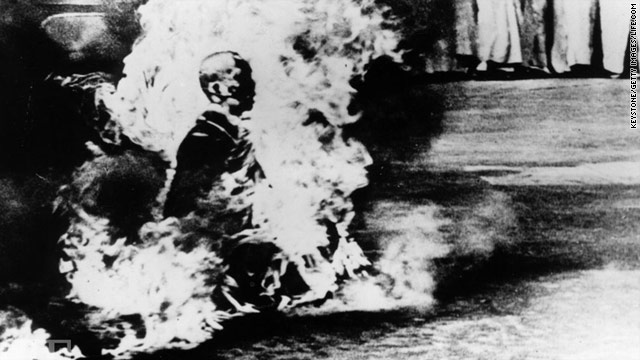
There, seated with his palms together and facing west, was their friend. Flames leapt around the peaceful man, engulfing him. It was just as he'd intended.
The year was 527.
This story of Daodu, a Buddhist monk, is told in James Benn's "Burning for the Buddha: Self-Immolation in Chinese Buddhism." Benn, an associate professor of religion at McMaster University in Ontario, Canada, writes that the act of setting one's self on fire dates back in Chinese Buddhist tradition to the late fourth century.
But no matter how old, self-immolation still leaves people horrified, riveted and moved.
The popular uprising that led to the toppling of Tunisia's government began after Mohamed Bouazizi, an unemployed 26-year-old college graduate, ignited himself in protest and died earlier this month. Since then, a wave of self-immolations has rolled through North Africa, with other incidents in Egypt, Algeria and Mauritania.
"There's something so primal, so dramatic. ... It's meant to be noticed," said Carolyn Marvin, a professor who's specialized in freedom of expression at the Annenberg School of Communications at the University of Pennsylvania. It seems to "demand some kind of reparation."
Though the history of self-immolation may run more than 1,500 years deep, the Western world woke up to it in the 1960s. The iconic June 1963 image of Thich Quang Duc, a Vietnamese Buddhist monk, surrounded by flames in a busy Saigon intersection was seared into Western consciousness.
He was protesting the persecution of Buddhists by the South Vietnamese government, and his actions are often seen as having helped spark the regime's overthrow later that year.
Others followed his example, not just in Vietnam but in the United States, too.
In March 1965, an 82-year-old woman, Alice Herz, protested the ongoing Vietnam War by setting herself on fire on a Detroit, Michigan, street corner. Norman Morrison, 31, ignited himself eight months later outside the Pentagon, beneath the office window of Defense Secretary Robert McNamara. The following week, Roger Allen LaPorte, 22, did the same in front of New York City's United Nations building.
In other countries, too, self-immolations have played a part in political and social movements.
There was Jan Palach, a 20-year-old student who in 1969 very publicly set himself on fire in Prague, Czechoslovakia, protesting Czech apathy five months after the Soviet occupation. Homa Darabi, a 54-year-old woman, did it in Iran in 1994 to demonstrate for women's rights after the Islamic Revolution. And a group of five burned together in 2001 at Tiananmen Square in Beijing, China, though three survived and the motivations are a matter of debate.
People have reportedly self-immolated in response to Communist regimes in Romania and Hungary, taxes in Sweden, the kidnapping of children by Chilean police. It's been done in Italy to protest the Catholic church's condemnation of homosexuality, in India to protest a film screening, and in the United Kingdom after an asylum claim was rejected.
The list of locations, and reasons, goes on.
But beyond political or social motivations, can faith inspire someone to burn themselves alive -- as it apparently did for Daodu in 527?
Of the well-known U.S. cases, which represent a diversity of backgrounds, it's next to impossible to say.
Herz, the 82-year-old Vietnam protester, was an immigrant of Jewish descent and had reportedly spent time in an internment camp during World War II. Morrison, who died outside the Pentagon, was a Quaker. LaPorte, who protested in flames in front of the United Nations, was a former seminary student and a member of the Catholic Worker Movement
In other cases, self-immolation has been more clearly linked to religious belief. Though outlawed in India for nearly two centuries, some Hindu communities practiced the ritual of sati -- in which a widowed Hindu woman would throw herself, or be thrown, on her husband's funeral pyre.
In Buddhism, the subject of self-immolation is controversial, said Robert Sharf, the chair of the Center for Buddhist Studies at the University of California, Berkeley.
"Many (Buddhist) schools strongly condemn suicide," he said, "but at the same time, in East Asia, self-immolation has been practiced on and off for well over a thousand years."
Like most religions, he said, the canonical literature is so vast that, if you dig deep enough, you can find teachings to fit your needs.
Enter the Lotus Sutra, considered one of the most significant Buddhist scriptures in East Asia. There's a small passage in one chapter that speaks of a Medicine King, one with great spiritual and moral wisdom.
"The Sutra tells us that as an offering to the Buddha and to display his insight that the body is not a permanent, unchanging self, he poured fragrant oil on himself and allowed himself to be burned by fire," wrote Buddhist monk, author, teacher and peace activist Thich Nhat Hanh is his book, "Peaceful Action, Open Heart."
"This is a quite radical demonstration of his freedom and insight, one that was made out of a very deep love," he wrote.
And it was this part of the Lotus Sutra that Vietnamese monks and nuns pointed to when it came to self-immolation in the 1960s.
But people don't burn themselves to death "simply because the Lotus Sutra says to do it," emphasized UC Berkeley's Sharf. "While it is an extreme and contentious practice, some Buddhists regard it as the ultimate form of self-sacrifice, justified in times of social crisis to bring about political transformation."
As for the recent self-immolations in North Africa, As'ad AbuKhalil said they are about sought-after change, not about religion.
"Western media still highly exaggerate the role and influence of Islam in political behavior and actions (and even violence by) Arabs and Muslims," said AbuKhalil, a political science professor at California State University, Stanislaus, and a blogger for a site called The Angry Arab News Service.
"The Tunisian uprising is clearly a secular event, and the Islamists have no role whatsoever in it. Not all actions by Arabs are derived by Islamic notions and principles."
He said there's "no basis in Islam for self-immolations" and that the practice came from "Asian non-Muslim societies." What's happening now "reveals not an attempt to express oneself Islamically, so to speak, but to express oneself in an act that draws attention and sympathy and shows the outrage experienced by the oppressed Arab population."
Marvin, the Penn communications professor, echoed his sentiments.
"These young men represent a fairly dispossessed class," she said. "It's as if they're offering up all that they have, their bodies, on behalf of the needs of their group."
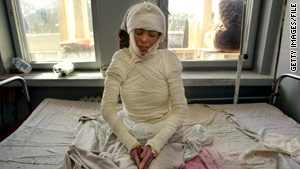
Though the intentions of those who ignite themselves cannot always be known, some trends can be surmised -- especially when those who act don't succeed in dying.
"They had set fire to themselves, so oppressed and desperate were they to escape abusive bad marriages," he wrote. The number of cases "had doubled in the past year," a doctor told him.
Some stories of self-immolations have become iconic. They, like the case of Bouazizi, seemed to galvanize others and force change.
But not all do.
In the United States, decades past Vietnam, at least two additional cases are thought to have been, at least in part, politically motivated, although the mental states of those who acted have been questioned.
Malachi Ritscher, 52, lit himself on fire near a downtown Chicago, Illinois, expressway in 2006. The musician and activist was said to be protesting the war in Iraq, but he was also reportedly a recovering alcoholic who battled depression.
Ten years before Ritscher set himself ablaze, a middle-aged woman did the same on Penn's campus in front of an outdoor sculpture of the peace symbol, Marvin said. She was Kathy Change.
"She was a very tall, willowy woman who would dance," across the campus," Marvin said. "She left a suicide note. And the saddest part of it was she had this idea that if she burned herself it would stop everyone in their tracks, and everyone would be good to each other."
Paul Root Wolpe, the director of Emory University's Center of Ethics in Atlanta, Georgia, was a sociology professor at Penn at that time.
In a letter he wrote to the student paper, The Daily Pennsylvanian, Wolpe -- who would later be asked to speak at Change's memorial service -- challenged students to not simply write her off as "deranged."
"She was the 'Dancing Lady' who often floated through campus waving a banner, spouting some vague references to love and political change. She was one of those characters who bring color to a college campus -- hard to ignore, but easy to dismiss -- and her final protest had the same character," he wrote.
Correo/ Chaviano-Gomez Manzano: COMIENZA A SESIONAR LA COMISIÓN AD HOC
#US, #China ink $45 bln of export deals
"We will be announcing that $45 billion of US export deals have been concluded, supporting 235,000 US jobs," the official said.
The total includes deals worth $25 billion spread over 70 contracts and 12 US states and a massive contract for Boeing.
"The Chinese government will announce that it will approve the purchase of 200 Boeing aircraft, with an estimated value of $19 billion dollars," the official said.
Chinese businesses have descended on the United States to coincide with Hu's four-day visit, inking agreements with US titans Alcoa, General Electric, Honeywell, Westinghouse and Caterpillar.
The deals span sectors as diverse as agriculture, gasification, railways and hybrid buses.
An additional three billion dollars' worth of Chinese investment in the United States has also been announced.
Trade spats have complicated relations in recent years, with US officials and lawmakers appearing increasingly exasperated about cheap Chinese products flooding the US market.
Washington has complained that Beijing has kept the value of its currency artificially low to boost its exports, risking dangerous imbalances in the global economy.
But US officials on Wednesday tried to shift the focus onto the benefits of trade with China, namely Chinese investment in the United States and US exports to China.
Both presidents and expected to meet with US and Chinese chief executives later in the day to underscore that message.
"(The) US firms are some of the major firms that have been exporting products to China, and the Chinese firms that have invested in the United States and created jobs in the United States," the US official said.
Condoleezza Rice: "'I cannot imagine myself running for office"
New York (CNN) -- Condoleezza Rice said she is enjoying life as a college professor outside the political realm, but she says the job is similar to her previous post -- secretary of state under former President George W. Bush.
"It has a lot of things in common," Rice said in an interview airing Wednesday on "Piers Morgan Tonight." "Trying to persuade 19-year-olds -- it's not all that different than trying to persuade some heads of state."
Asked whether she would ever seek an elected position, Rice said, "I cannot imagine myself running for office. Not because politics are so tough, but it's just not me."
She currently is a professor of political science at Stanford University and a professor of political economy in the university's graduate school of business. She's been at Stanford nearly 30 years, she said.
"It's certainly different being out of power," Rice said. "You can read the newspaper and you can say, 'Oh, isn't that interesting?' You can go on to the next page if you like, which I rather enjoy."
Being a public servant, she said, is different than seeking votes. "There's no greater challenge and there is no greater honor than to be in public service. ... Sometimes we tend to impugn the motives of public servants, but I can assure you they're not there for the glory. They're not there for themselves."
"I'm not very young anymore," she said, explaining why she doesn't want to run for office. "What are you, 30?" Morgan asked. "Thank you," she replied. "Thirty-nine?" he asked. "We'll leave it at that," she said. (For the record, she's 56.)
--Condoleezza Rice
Her ideal man, she said, would like to watch football with her all day -- "I can watch football for hours on end" -- and would like classical music. An accomplished pianist, Rice said she harbored hopes of becoming a concert pianist one day, but now believes she wasn't good enough to attain that. She still plays piano daily, she said, and recalls her proudest moment as playing with cellist Yo-Yo Ma.
Asked what kind of men she finds attractive, she told Morgan, "I don't do hypothetical ... I've never met anybody that I wanted to live with. Now, when I do, I'll let you know."
However, she said she's "actually quite easy to get along with" and no slouch in the kitchen.
"I'd cook you fried chicken," she told Morgan. "Southern fried chicken. I would cook chili perhaps. Uh, corn bread. I'm quite good at corn bread. Or perhaps because of my half-Creole grandmother, I'd cook you gumbo."
Aggregate Demand and Aggregate Supply/ Paul Krugman
This is confusing demand with supply.
We really did produce all the goods and services counted in GDP; we were able to do that because we had willing workers, a sufficient capital stock, the right technology, and so on.
What is true is that some of the spending that created demand for those goods and services was debt-financed, and those debtors can’t continue to spend the way they did. But that doesn’t say that the capacity has somehow ceased to exist; it only says that if we want to keep the capacity in use, someone else has to spend instead. In other words, past growth wasn’t an illusion, or a fraud; but we need policies to sustain aggregate demand.
And yes, I have a model.
Hu Jintao: "Mucho por resolver sobre DDHH en China"
Hu hablaba así durante una rueda de prensa en la Casa Blanca junto al presidente estadounidense, Barack Obama, con quien se reunió hoy por espacio de dos horas dentro de la visita del jefe de Estado de la República Popular a Washington, citó Efe.

Sin embargo, haciendo dudar mas que razonablemente del sentido de sus palabras, todavia permanecen en las carceles decenas de miles de pacificos opositores entre ellos el Premio Nobel de la Paz Liu Xiaobo, y recientemente un reconocido opositor fue atropellado en un misterioso accidente de transito.
Iranium -The Film Iran's Leaders Don't Want You to See [#Canada gets a threat, then cancels]
After receiving threats and two suspicious letters Tuesday, the National Archives of Canada cancelled the screening of a controversial documentary that critiques Iran’s nuclear weapons program, a move that has organizers questioning the national library’s autonomy.The Free Thinking Film Society’s showing of Iranium prompted so many complaints — some of them from the Iranian Embassy — that staff thought it necessary to close the entire building at 396 Wellington St. in Ottawa, just steps from the Supreme Court of Canada and Parliament Hill at 4:45 p.m., said archives spokeswoman Pauline Portelance.“Once we started to receive threats from the public and threats of public protest, we deemed the risk associated with the event was a little too high,” she said.
Climate change study had 'significant error': experts
The study was posted on the website of the American Association for the Advancement of Science and was written about by numerous international news agencies, including AFP.But AAAS later retracted the study as experts cited numerous errors in its approach.
"A reporter with The Guardian alerted us yesterday to concerns about the news release submitted by Hoffman & Hoffman public relations," said AAAS spokeswoman Ginger Pinholster in an email to AFP.
"We immediately contacted a climate change expert, who confirmed that the information raised many questions in his mind, too. We swiftly removed the news release from our Web site and contacted the submitting organization."
Scientist Osvaldo Canziani, who was part of the 2007 Nobel Prize winning Intergovernmental Panel on Climate Change, was listed as the scientific advisor to the report.
The IPCC, whose figures were cited as the basis for the study's projections, and Al Gore jointly won the Nobel Prize for Peace in 2007 "for their efforts to build up and disseminate greater knowledge about man-made climate change," the prize committee said at the time.
Canziani's spokesman said Tuesday he was ill and was unavailable for interviews.
The study cited the UN group's figures for its projections, combined with "the business-as-usual path the world is currently following," said lead author Liliana Hisas of the Universal Ecological Fund (UEF), a non-profit group headquartered in Argentina.
But climate scientist Rey Weymann told AFP that the "study contains a significant error in that it confuses 'equilibrium' temperature rise with 'transient temperature rise.'"
He also noted that study author Hisas was told of the problems in advance of the report's release.
"The author of the study was told by several of us about this error but she said it was too late to change it," said Weymann.
Scientist Scott Mandia forwarded to AFP an email he said he sent to Hisas ahead of publication explaining why her figures did not add up, and noting that it would take "quite a few decades" to reach a warming level of 2.4 degrees Celsius.
"Even if we assume the higher end of the current warming rate, we should only be 0.2C warmer by 2020 than today," Mandia wrote.
"To get to +2.4C the current trend would have to immediately increase almost ten-fold."
Mandia described the mishap as an "honest and common mistake," but said the matter would certainly give fuel to skeptics of humans' role in climate change.
"More alarmism," said Mandia. "Don't get me wrong. We are headed to 2.4, it is just not going to happen in 2020."
Many people do not understand the cumulative effect of carbon emissions and how they impact climate change, Mandia said.
"This is something that people don't appreciate. We tied a record in 2010 (for temperature records) globally. That is primarily from the C02 we put in the atmosphere in the 70s and early 80s, and we have been ramping up since then," he said.
"So it is not good. We are seeing the response from a mistake we were making 20 years ago, and we are making bigger mistakes today."
The public relations firm that issued the report on the UEF's behalf said the group stands by the study and would issue a statement to that effect.
#Cuba/ Yohandry: "#Yoani se expone ....a una buena patada en el culo"
El camarada que se hace llamar Yohandry Fontana, que no es mas que un agente a tiempo completo de la direccion de inteligencia cubana en internet, expresa lo siguiente:
Los tiempos equilibrantes de pateadores y receptores se estan acercando de tal manera, que sera conveniente poner limites sociales, so pena que de la inmensa mayoria de los culos broten patadas dirigidas a los pateadores culeados.
martes, enero 18, 2011
Pronostico de salud de Steve Jobs

#Cuba: Is Heroism a Sign of Brain Disease?
House Watch: Is Heroism a Sign of Brain Disease?
Retratos de fusilados por el Castrismo - Juan Abreu
"Hablame"
"EN TIEMPOS DIFÍCILES" - Heberto Padilla
A aquel hombre le pidieron su tiempo
para que lo juntara al tiempo de la Historia.
Le pidieron las manos,
porque para una época difícil
nada hay mejor que un par de buenas manos.
Le pidieron los ojos
que alguna vez tuvieron lágrimas
para que contemplara el lado claro
(especialmente el lado claro de la vida)
porque para el horror basta un ojo de asombro.
Le pidieron sus labios
resecos y cuarteados para afirmar,
para erigir, con cada afirmación, un sueño
(el-alto-sueño);
le pidieron las piernas
duras y nudosas
(sus viejas piernas andariegas),
porque en tiempos difíciles
¿algo hay mejor que un par de piernas
para la construcción o la trinchera?
Le pidieron el bosque que lo nutrió de niño,
con su árbol obediente.
Le pidieron el pecho, el corazón, los hombros.
Le dijeron
que eso era estrictamente necesario.
Le explicaron después
que toda esta donación resultaria inútil.
sin entregar la lengua,
porque en tiempos difíciles
nada es tan útil para atajar el odio o la mentira.
Y finalmente le rogaron
que, por favor, echase a andar,
porque en tiempos difíciles
esta es, sin duda, la prueba decisiva.
Etiquetas
ANALISIS ESPECIALES SOBRE EL NEOKAXTRIZMO
- 89,000 razones para el cambio
- Análisis del neocastrismo entre huevos con jamón y tostadas
- Aproximación a Cuba desde la Teoría del Caos ( I )
- Biología y sucesión ( 2 ): La política económica de la subsistencia
- Biología y sucesión: El Pacto de los Comandantes y el Pacto de los Generales
- Biología y sucesión: ¿A quién mejor que a la familia?
- Cuba, entre la lógica y la incertidumbre
- Cuba: Crisis del sistema bancario o crisis del pensamiento económico
- Cuba: Las reformas y la empresa pública del Neocastrismo I
- Cuba: Las reformas y la empresa pública del neocastrismo ( II )
- Cuba: Nudos Gordianos o ¿dónde dejaron el portaaviones?
- Del Castrismo a la castracion
- Economia Politica de la Transicion en Cuba [1]
- Economía política de la transición (2): La pobreza estructural como mecanismo de dominación
- Economía política de la transición (3): Las claves de la pobreza estructural
- El Neocastrismo posible
- El Síndrome del Neocastrismo
- El Zhuanda Fangxiao cubano: mantener lo grande, deshacerse de lo pequeño/
- El caos y la logica difusa en el Castrismo
- El estado de bienestar del Neocastrismo: “Lucha tu alpiste pichón”
- El menú del neocastrismo: pato pekinés y hallacas venezolanas/ Eugenio Yáñez
- El neocastrismo: “revolución” sin ideología
- El secuestro de la Ciencia Cubana por Fidel Castro
- El ¨sucre¨: fracaso anunciado de un golpe de estado
- Elecciones en Cuba: Control Político, Manipulación y Testosterona Biranica [II]
- Elecciones en Cuba: Control Político, Manipulación y Testosterona Biranica [I]
- Estrategias medievales en el siglo XXI
- La antesala del entierro político de Fidel Castro
- La caja de Pandora del castrismo: la sucesión
- La ¨Rana Hirviendo¨ del Castrismo
- Los caminos hacia la Cuba post-castrista
- Los funerales del hombre nuevo
- Los múltiples síndromes del "Papá Estado" cubano
- Neocastrismo y Vaticano: liturgias y Vía Crucis. El camino de Tarzán
- Neocastrismo, diplomacia "revolucionaria" y wikiboberías
- Por un puñado de dólares
- Raúl Castro en el año del Dragón ( I )
- TRES AÑOS DE RAULISMO ( I I I, FINAL): Sombras nada más
- Unificación Monetaria en Cuba: Un arroz con mango neocastrista [1]
- Unificación Monetaria en Cuba: Un arroz con mango neocastrista [2]
- Unificación Monetaria en Cuba: arroz con mango neocastrista [FINAL]
- Vivienda y Castrismo. La mezcla se endurece
- ¿Perestroika a la cubana?
GLOBAL
- ChartsBin
- DEBKAfile
- Daily Planet Map
- Economist Intelligence Unit
- Estadisticas mundiales en tiempo real
- Foreign Affairs
- Fox Nation
- Fragilecologies
- Global Incident Map
- Global Security
- Human Progress
- InfoWars
- New Zeal
- NewScientist
- Power Wall
- Pulitzer Center
- Ted Ideas
- The Albert Einstein Institution
- The Blaze
- The Daily Beast
- The Global Report
- The National Security Archive
- The Peak
- Trends Research Institute
- What does it mean
- World Audit
- ZeroHedge
- ipernity
Cuba
Seguidores
Carta desde la carcel de Fidel Castro Ruz
“…después de todo, para mí la cárcel es un buen descanso, que sólo tiene de malo el que es obligatorio. Leo mucho y estudio mucho. Parece increíble, las horas pasan como si fuesen minutos y yo, que soy de temperamento intranquilo, me paso el día leyendo, apenas sin moverme para nada. La correspondencia llega normalmente…”
“…En cuanto a fumar, en estos días pasados he estado rico: una caja de tabacos H. Upman del doctor Miró Cardona, dos cajas muy buenas de mi hermano Ramón….”.
“Me voy a cenar: spaghettis con calamares, bombones italianos de postre, café acabadito de colar y después un H. Upman #4. ¿No me envidias?”.
“…Me cuidan, me cuidan un poquito entre todos. No le hacen caso a uno, siempre estoy peleando para que no me manden nada. Cuando cojo el sol por la mañana en shorts y siento el aire de mar, me parece que estoy en una playa… ¡Me van a hacer creer que estoy de vacaciones! ¿Qué diría Carlos Marx de semejantes revolucionarios?”.
Quotes
"No temas ni a la prision, ni a la pobreza, ni a la muerte. Teme al miedo" - Giacomo Leopardi
¨Por eso es muy importante, Vicky, hijo mío, que recuerdes siempre para qué sirve la cabeza: para atravesar paredes¨– Halvar de Flake [El vikingo]
"Como no me he preocupado de nacer, no me preocupo de morir" - Lorca
"Al final, no os preguntarán qué habéis sabido, sino qué habéis hecho" - Jean de Gerson
"Si queremos que todo siga como está, es necesario que todo cambie" - Giuseppe Tomasi di Lampedusa
"Todo hombre paga su grandeza con muchas pequeñeces, su victoria con muchas derrotas, su riqueza con múltiples quiebras" - Giovanni Papini
"Life is what happens while you are busy making other plans" - John Lennon
"Habla bajo, lleva siempre un gran palo y llegarás lejos" - Proverbio Africano
"No hay medicina para el miedo" - Proverbio escoces
"El supremo arte de la guerra es doblegar al enemigo sin luchar" - Sun Tzu
"You do not really understand something unless you can explain it to your grandmother" - Albert Einstein
"It is inaccurate to say I hate everything. I am strongly in favor of common sense, common honesty, and common decency. This makes me forever ineligible for public office" - H. L. Menken
"I swore never to be silent whenever and wherever human beings endure suffering and humiliation. We must always take sides. Neutrality helps the oppressor, never the victim. Silence encourages the tormentor, never the tormented" - Elie Wiesel
"Stay hungry, stay foolish" - Steve Jobs
"If you put the federal government in charge of the Sahara Desert , in five years ther'ed be a shortage of sand" - Milton Friedman
"The tragedy of modern man is not that he knows less and less about the meaning of his own life, but that it bothers him less and less" - Vaclav Havel
"No se puede controlar el resultado, pero si lo que uno haga para alcanzarlo" - Vitor Belfort [MMA Fighter]
Liborio
A la puerta de la gloria está San Pedro sentado y ve llegar a su lado a un hombre de cierta historia. No consigue hacer memoria y le pregunta con celo: ¿Quién eras allá en el suelo? Era Liborio mi nombre. Has sufrido mucho, hombre, entra, te has ganado el cielo.
Para Raul Castro
Cuba ocupa el lugar 147 entre 153 paises evaluados en "Democracia, Mercado y Transparencia 2007"
Enlaces sobre Cuba:
- ALBERTO MÜLLER
- Abicu Liberal
- Agencia de Prensa Libre Oriental
- Asociation for the study of the Cuban Economy
- Babalu blog
- Bitacora Cubana
- Centro de Estudios de la Economia Cubana
- Cine Cuba
- Conexion Cubana
- Conexion Cubana/Osvaldo
- Cuba Futuro
- Cuba Independiente
- Cuba Matinal
- Cuba Net
- Cuba Standard
- Cuba Study Group
- Cuba al Pairo
- Cuba transition project
- Cuba/ Brookings Institution
- CubaDice
- Cubanalisis
- Cubano Libre blog
- Cubanology
- DAZIBAO-Ñ-.
- El Blog del Forista 'El Compañero'
- El Republicano Liberal
- El Tono de la Voz
- Emilio Ichikawa blog
- Enrisco
- Estancia Cubana
- Esteban Casañas Lostal/ La Isla
- Estudios Económicos Cubanos
- Exilio Cubano
- Fernando Gonzalez
- Freedom for Dr. Biscet!
- Fundacion Canadiense para las Americas: Cuba
- Fundacion Lawton de Derechos Humanos
- Gaspar, El Lugareño
- Global Security
- Granma
- Guaracabuya: Organo Oficial de la Sociedad Economica de Amigos del Pais
- Humanismo y Conectividad
- Humberto Fontova
- IRI: International Republic Institute
- Ideas Ocultas
- Jinetero,... y que?
- La Finca de Sosa
- La Nueva Cuba
- La Primavera de Cuba
- La pagina del Dr. Antonio de la Cova
- Lista de blogs cubanos
- Los Miquis
- Magazine Cubano
- Manuel Diaz Martinez
- Martha Beatriz Roque Info
- Martha Colmenares
- Medicina Cubana
- Movimiento HUmanista Evolucionario Cubano
- Neoliberalismo
- Net for Cuba International
- Nueva Europa - Nueva Arabia
- Oficina Nacional de Estadisticas de Cuba
- Penultimos Dias
- Pinceladas de Cuba
- Postal de Cuba
- Real Instituto Elcano
- Repensando la rebelión cubana de 1952-1959
- Revista Hispano Cubana
- Revista Voces Voces
- Secretos de Cuba
- Sociedad Civil Venezolana
- Spanish Pundit
- SrJacques Online: A Freedom Blog
- Stratfor Global Intelligence
- TV Cuba
- The Havana Note
- The Investigative Project on Terrorism
- The Real Cuba
- The Trilateral Commission
- Union Liberal Cubana/Seccion de Economia y Finanzas
- White House
- Yo Acuso al regimen de Castro
Cuando vinieron
Cuando vinieron a buscar a los sindicalistas, Callé: yo no soy sindicalista.
Cuando vinieron a buscar a los judíos, Callé: yo no soy judío. Cuando vinieron a buscar a los católicos, Callé: yo no soy “tan católico”.
Cuando vinieron a buscarme a mí, Callé: no había quien me escuchara.
Reverendo Martin Niemöller
Articulos especiales
- * Analisis del saldo migratorio externo cubano 2001-2007
- * Anatomía de un mito: la salud pública en Cuba antes y después de 1959
- * Cuba: Sistema de acueductos y alcantarillados
- * ELECCIONES: Un millon ciento cincuenta y dos mil personas setecientas quince personas muestran su oposicion al regimen
- * El Trinquenio Amargo y la ciudad distópica: autopsia de una utopía/ Conf. del Arq. Mario Coyula
- * Estructura del PIB de Cuba 2007
- * Las dudas de nuestras propias concepciones
- * Republica y rebelion
- Analisis de los resultados de la Sherrit en Cuba
- Circulacion Monetaria: Tienen dinero los cubanos para "hacerle" frente a las medidas "aperturistas" de Raul?
- Cuba-EEUU: Los círculos viciosos y virtuosos de la transición cubana [ 3] / Lazaro Gonzalez
- Cuba-EEUU: Los círculos viciosos y virtuosos de la transición cubana [ I ]/ Lazaro Gonzalez
- Cuba-Estados Unidos: Los Círculos Viciosos y Virtuosos de la transición cubana [ I I ]- Lazaro Gonzalez
- Cuba: Comercio Exterior 2007 y tasas de cambio
- Cuba: Reporte de turistas enero 2008
- Cuba: Sondeo de precios al Mercado Informal
- Estudio de las potencialidades de la produccion de etanol en Cuba
- Reforma de la agricultura en Cuba: Angel Castro observa orgulloso al Sub-Latifundista de Biran al Mando*
- Turismo en Cuba: Un proyecto insostenible. Analisis de los principales indicadores
- Unificación Monetaria en Cuba: Un arroz con mango neocastrista [1]
CUBA LLORA Y EL MUNDO Y NOSOTROS NO ESCUCHAMOS
Donde estan los Green, los Socialdemocratas, los Ricos y los Pobres, los Con Voz y Sin Voz? Cuba llora y nadie escucha.
Donde estan el Jet Set, los Reyes y Principes, Patricios y Plebeyos? Cuba desesperada clama por solidaridad.
Donde Bob Dylan, donde Martin Luther King, donde Hollywood y sus estrellas? Donde la Middle Class democrata y conservadora, o acaso tambien liberal a ratos? Y Gandhi? Y el Dios de Todos?
Donde los Santos y Virgenes; los Dioses de Cristianos, Protestantes, Musulmanes, Budistas, Testigos de Jehova y Adventistas del Septimo Dia. Donde estan Ochun y todas las deidades del Panteon Yoruba que no acuden a nuestro llanto? Donde Juan Pablo II que no exige mas que Cuba se abra al Mundo y que el Mundo se abra a Cuba?
Que hacen ahora mismo Alberto de Monaco y el Principe Felipe que no los escuchamos? Donde Madonna, donde Angelina Jolie y sus adoptados around de world; o nos hara falta un Brando erguido en un Oscar por Cuba? Donde Sean Penn?
Donde esta la Aristocracia Obrera y los Obreros menos Aristocraticos, donde los Working Class que no estan junto a un pueblo que lanquidece, sufre y llora por la ignominia?
Que hacen ahora mismo Zapatero y Rajoy que no los escuchamos, y Harper y Dion, e Hillary y Obama; donde McCain que no los escuchamos? Y los muertos? Y los que estan muriendo? Y los que van a morir? Y los que se lanzan desesperados al mar?
Donde estan el minero cantabrico o el pescador de percebes gijonese? Los Canarios donde estan? A los africanos no los oimos, y a los australianos con su acento de hombres duros tampoco. Y aquellos chinos milenarios de Canton que fundaron raices eternas en la Isla? Y que de la Queen Elizabeth y los Lords y Gentlemen? Que hace ahora mismo el combativo Principe Harry que no lo escuchamos?
Donde los Rockefellers? Donde los Duponts? Donde Kate Moss? Donde el Presidente de la ONU? Y Solana donde esta? Y los Generales y Doctores? Y los Lam y los Fabelo, y los Sivio y los Fito Paez?
Y que de Canseco y Miñoso? Y de los veteranos de Bahia de Cochinos y de los balseros y de los recien llegados? Y Carlos Otero y Susana Perez? Y el Bola, y Pancho Cespedes? Y YO y TU?
Y todos nosotros que estamos aqui y alla rumiando frustaciones y resquemores, envidias y sinsabores; autoelogios y nostalgias, en tanto Louis Michel comulga con Perez Roque mientras Biscet y una NACION lanquidecen?
Donde Maceo, donde Marti; donde aquel Villena con su carga para matar bribones?
Cuba llora y clama y el Mundo NO ESCUCHA!!!
Suscribirse Cuba Independiente
CIF: Cuba Independiente http://CubaIndependiente.blogspot.com Registro (c) Copyright: ® DIN 189297780000 Gerente By: www.copyrightwww.com